Perhaps it is a case of lofty valuations finally coming home to roost. Or maybe it is just a correction before the start of another move higher.
Whatever the case may be, social media stocks have rapidly fallen out of favor with investors in recent weeks, sapping the exchange traded funds where those stocks make homes. Coincidence or not, the downturn in social media stocks has accelerated since Twitter (NYSEArca: TWTR), one of the more ballyhooed initial public offerings in recent memory, made its debut as a public company. [A Cautious View on Facebook, Twitter ETFs]
With Monday’s 4.7% loss, Twitter has plunged 13.4% since its Nov. 7 IPO. Mark Zuckerberg’s Facebook (NasdaqGM: FB) has tumble 14% in the past month. It looks like weakness in the social media industry is starting to catchup with the Global X Social Media Index ETF (NasdaqGS: SOCL). SOCL is up half a percent since Twitter’s IPO, but that stock, among others, has pressured the ETF in recent days.
Since SOCL added Twitter at a weight if 4.5% (now 4.27%) on Nov. 15, the ETF is off almost 4%. It is not just Twitter and Facebook that are pressuring, SOCL and other Internet ETFs. LinkedIn (NYSE: LNKD) has dipped 11% since Oct. 25. [Social Media ETF Adds Twitter]
Those three stocks combine for 24% of SOCL’s weight and are contributors, Facebook and LinkedIn in particular to SOCL’s 34.5 P/E and price-to-book ratio of almost 4.2. Lofty Internet/social media valuations are not confined to SOCL. [Trouble for These ETFs if the Four Horsemen Don’t Ride]
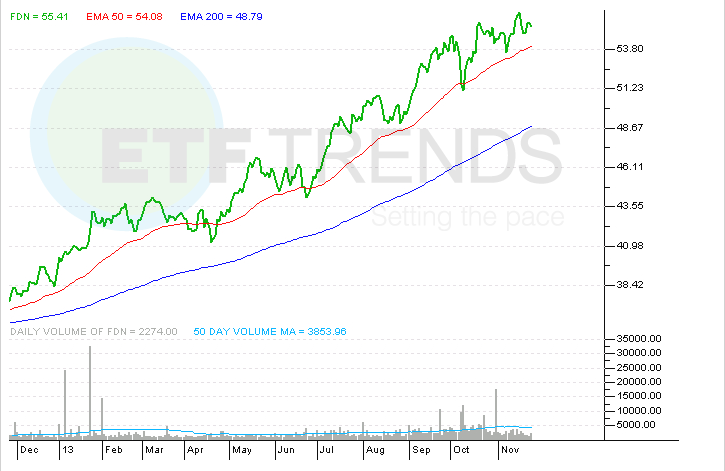
The First Trust Dow Jones Internet Index Fund (NYSEArca: FDN) has eked out a modest gain over the past 30 days. Twitter is not found on FDN’s 41-stock lineup, but Facebook, LinkedIn, Amazon (NasdaqGM: AMZN) and Netflix (NasdaqGM: NFLX), none of which can be considered cheap, combine for 22% of the ETF’s weight. FDBN’s P/E is 33.1 and its price/sales ratio is nearly 3.1, according to issuer data.
With the lofty valuations on the aforementioned Internet names and others, talk has increased that Internet stocks are on the cusp of another 1999-2000-style bubble. To be sure, investors have not been shy about pouring cash into FDN and SOCL this year as the two have seen dramatic asset growth on a percentage basis.
FDN has taken in almost $755 million of its nearly $1.7 billion in AUM this year while $92.4 million, or 87%, of SOCL’s assets have come into the fund this year.
The good news is talk of another Internet bubble may be unfounded. The NASDAQ 100 traded with a P/E of 150 in late 1999, more than seven times where it trades today. [The Changing Face of QQQ]
First Trust Dow Jones Internet Index Fund