Exchange traded funds that subscribe to momentum strategies have been around longer than the recent craze surrounding intelligent indexing would seem to indicate.
One of the more seasoned members of the momentum ETF group is the PowerShares DWA Emerging Markets Momentum Portfolio (NYSEArca: PIE). Home to one of the more memorable tickers in the ETF arena, PIE is about a month shy of its sixth anniversary with $362.3 million in assets under management, indicating the idea of applying momentum investing to emerging markets equities has proven successful. [The Best Emerging Markets ETFs]
PIE’s momentum-based emphasis means the ETF’s lineup is often overweight select developing markets while being underweight others compared to the MSCI Emerging Markets Index. PIE tracks the Dorsey Wright Emerging Markets Technical Leaders Index.
For example, at the start of the fourth quarter, PIE was underweight the BRIC nations, but was overweight Mexico, South Africa, Taiwan and Turkey. PIE is also underweight South Korea, though Asia’s fourth-largest economy is the fund’s fourth-largest country weight at 12.4%, giving PIE some leverage to what has recently been one of the better-performing emerging markets. [PIE Slices: How This Popular ETF Will Look in Q4]
PIE “tends to perform best, relative to the cap-weighted MSCI Emerging Markets Index benchmark, when there is a large difference between the best- and worst-performing emerging-markets countries. This fund also does not have some of the drawbacks of a cap-weighted index fund–namely, a consistent, significant exposure to government-controlled entities and global cyclical firms,” writes Morningstar ETF analyst Patricia Oey.
Still, PIE’s rivals such as the iShares MSCI Emerging Markets ETF (NYSEArca: EEM) and the Vanguard FTSE Emerging Markets ETF (NYSEArca: VWO) are not light on state-run companies or cyclical sectors. More than half of VWO’s top-10 holdings are state-controlled firms. In EEM, energy and materials stocks combine for over 21% of the ETF’s weight.
PIE takes a different approach to cyclical sectors as discretionary names account for almost 18% of the ETF’s weight, roughly double what is found in EEM. That says PIE is more levered to the emerging markets consumer story than some of its rivals. Additionally, while PIE does have a health 17.4% weight to financial services names, that is well below what EEM and VWO allocate to the same sector. [Loan Problems Weigh on China ETFs]
“Over the past five years, this fund’s standard deviation of returns of 23% was in line with that of the MSCI Emerging Markets Index. During relatively calm markets, this fund tends to be less volatile than the MSCI Emerging Markets Index. However, during periods of high market volatility, momentum strategies become extremely fickle and can significantly underperform,” notes Oey.
Still, PIE has some factors working in its favor. The ETF’s combined weight to consumer sectors is over 28% and its overall cyclical exposure its favorable for investors betting on an emerging markets rebound in 2014 after a year of under-performance in 2013.
Additionally, with the market at the start of its best six-month period, the time could be right consider PE because of the ETF’s legacy of solid returns in the November through April 30 time frame. [An ETF Two-Step for EM Seasonality]
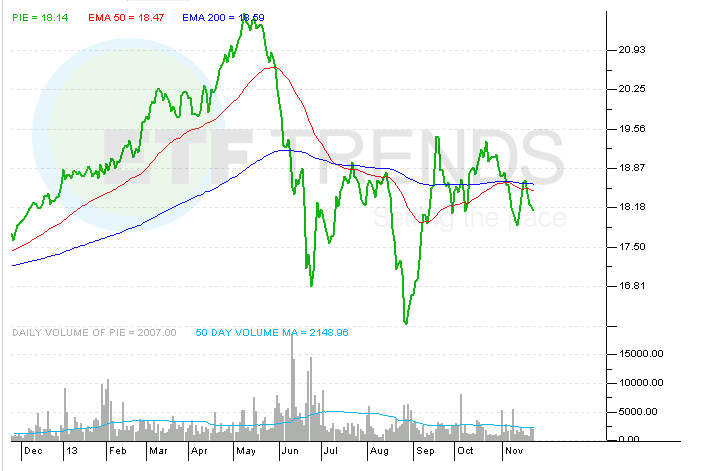
PowerShares DWA Emerging Markets Momentum Portfolio
ETF Trends editorial team contributed to this post. Tom Lydon’s clients own shares of EEM.