There are more than 20 exchange traded funds offering investors exposure to municipal bonds, which at the end of the first quarter represented over $3.7 trillion, or 9.6%, of the total U.S. bond market.
Many of the largest muni bond ETFs, such as the iShares S&P National AMT-Free Muni Bond ETF (NYSEArca: MUB) and the SPDR Nuveen Barclays Municipal Bond ETF (NYSEArca: TFI) are heavily allocated to general obligation (GO) bonds, or those bonds that are backed by the credit and taxing ability of a city or state. [Muni Bond ETFs Shift Gears in 2013]
At a time when some of the largest U.S. states, including California and Illinois, are awash in massively under-funded public employee pension obligations, some investors are looking to diversify away from GO bonds while still keeping exposure to munis.
The newly minted db X-trackers Municipal Infrastructure Revenue Bond Fund (NYSEArca: RVNU) is the ETF that offers investors diversification away from GO munis. RVNU is the first ETF to focus exclusively on revenue bonds, or those munis that are supported by revenue from projects such as toll roads or bridges. [Deutsche Bank’s Expanding ETF Presence]
RVNU debuted in early June, but the fund’s rookie status has not stopped some advisors from embracing it right out of the gate.
“We’ve been buying RVNU fairly actively since September,” said Christian Wagner of Delaware-based Longview Capital in an interview with ETF Trends.
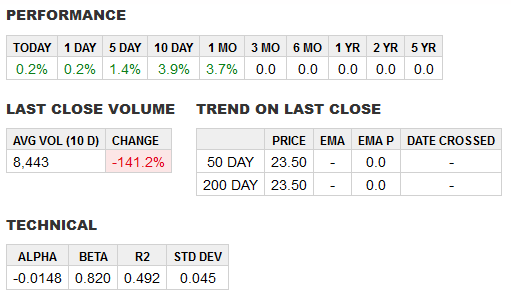
Wagner noted that not only are the yield traits of munis currently favorable relative to taxable bonds, but also that RVNU’s relative returns based on the fund’s volatility are too compelling to ignore. RVNU is up 3.7% in the past month, more than double what MUB has returned over the same time.
“We like RVNU because of the holdings and expected infrastructure spending,” said Wagner. “Numbers show the U.S. will have to spend $4 trillion over the next 15 years to upgrade infrastructure. Limited supply in infrastructure means it needs to be replaced and it has to be done with new bond issues.”
RVNU’s index is intended to track federal tax-exempt municipal bonds that have been issued with the intention of funding federal, state and local infrastructure projects such as water and sewer systems, public power systems, toll roads, bridges, tunnels, and many other public use projects. The index will attempt to only hold those bonds issued by state and local municipalities where the interest and principal repayments are generated from dedicated revenue sources. [Muni Bond ETFs Sidestep Default Worries]
Nearly two-thirds of RVNU’s combined weight is allocated to transportation and water and sewer bonds. RVNU has nearly 600 holdings with modified duration to worst of 7.5 years and a yield to worst of 4.6%, according to issuer data. Over 84% of the fund’s holdings are rated AA or A.
Still, the most important advantage RVNU offers investors might just be that it steers clear of a possible pension nightmare. Recent research “into the funded status of state level defined benefit public pension plans reveals that public employee retirement promises are underfunded by $4.1 trillion. Combined, state public pension plans are just 39 percent funded,” according to State Budget Solutions.
“Our job is to perform due diligence to help clients preserve wealth and RVNU does that,” said Wagner. “One of the reasons we focused on RVNU is because it strips out general obligation bonds and avoids pension risk.”
db X-trackers Municipal Infrastructure Revenue Bond Fund