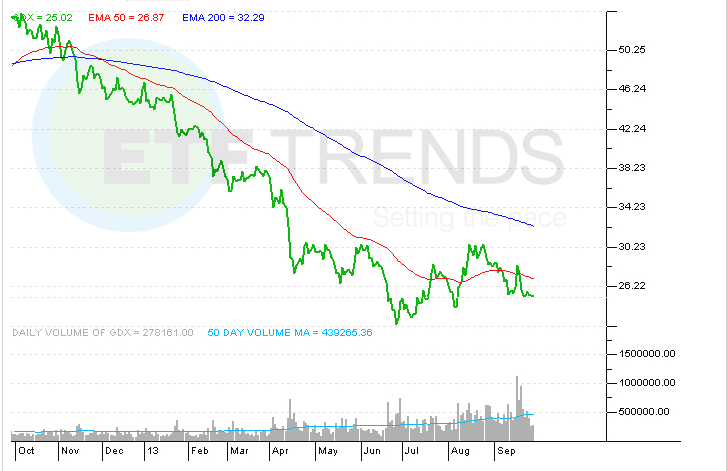
Again under siege with gold trading at its lowest levels since early August, mining ETFs such as the Market Vectors Gold Miners ETF (NYSEArca: GDX) have plenty to worry about, including what life could look like if bullion falls below $1,000 per ounce.
Gold futures are trading around $1,286 per ounce at this writing. The yellow metal turned in its best quarterly performance of the year in third quarter as the SPDR Gold Shares (NYSEArca: GLD) rose 5.8%, but GDX, the largest gold mining ETF, eked out a gain of just half a percent. Tuesday’s downdraft could be a sign that October is set to live up to its billing as dreadful month for gold bulls.
Since the start of this century, October ranks as merely the tenth-best, or third-worst, month in which to own gold. That is only slightly better than the 1990s, when October was the second-worst month for gold. In the 1980s, October was gold’s tenth-best month and overall since 1980, October is the worst month for the yellow metal. [Gold’s Short-Lived Fed-Fueled Gains]
Things could worse before they get better for the already embattled miners. With gold prices struggling to stay above $1,300 an ounce, the spotlight is back on which miners are burning cash and which ones can profitably extract bullion from the earth when spot prices tumble to $1,300 or $1,200 per ounce or even lower. According to a Citigroup research note, global gold on mine unit costs rose 12% year-over-year in the June 2013 quarter. Due to the combination of rising costs and falling gold prices, gold miners have witnessed a quick contraction in margins. [Mining ETFs Flirt With Disaster After Rocky September]
On Tuesday, Fitch Ratings offered up an ominous forecast for gold miners if spot prices tumble below $1,000 per ounce.
“One danger is that companies live in the false expectation of continued high prices and accompanying asset price bubbles. As history has proven, some companies (commodity companies included) undertake M&A at a cyclical peak, and/or incur substantial expenditure to develop mines with returns based on continued high prices, only to find the company’s peak in capex is less supported by sustainable cash flow as the commodity price declines. This can be exacerbated if the expansions are debt-funded. Newcrest’s (unrated) financial profile is one such example of being caught in this post-M&A scenario. However, based on recent discussions with Fitch-rated issuers, no companies are operating under the false expectation of a rebound in prices. Indeed, recent earnings calls for most gold producers have focused on cash-flow generation in a lower price environment,” the ratings agency said in a note posted by Barron’s.
Some miners may be able to remain profitable if gold prices drop below $1,000. For instance, Barrick Gold (NYSE: ABX) calculates that its all-in sustaining costs at around $900 to $975 per ounce for 2013. In August, Cowen noted Goldcorp (NYSE: GG) and Yamana Gold (NYSE: AUY) would still be to generate positive earnings amid significant gold price retrenchment. Those stocks combine for 19% of GDX’s weight. Yamana’s all-in-cash costs are below $860 an ounce, indicating the company could still be profitable if gold trades only slightly above $900. [30% Plunge Could Mean Disaster for Mining ETFs]
Goldcorp, Barrick and Yamana combine for over 27% of GDX’s weight.
Market Vectors Gold Miners ETF
ETF Trends editorial team contributed to this post. Tom Lydon’s clients own shares of GLD.