At the sector level, consumer staples, telecom and utilities are among income investors’ favorite destinations. Far from being growth names, stocks residing in those sectors are usually viewed as value plays and, as a result, dividend investing is often thought to be value investing.
However, just how much value those sectors are currently offering is debatable and with staples and utilities trading at elevated valuations, some popular dividend ETFs could be getting a tad pricey themselves.
Mebane Faber, portfolio manager at Cambria Investment Management, said one of his biggest concerns is high yield stocks in the U.S. while pointing out that the relative P/E of high-yield fare from defensive sectors is now elevated relative to historical norms.
That could represent a cautionary tale for some of the largest U.S.-focused dividend ETFs, such as the Vanguard Dividend Appreciation ETF (NYSEArca: VIG), the iShares Select Dividend ETF(NYSEArca: DVY) and the SPDR S&P Dividend ETF (NYSEArca: SDY). Combined, those ETFs have nearly $43.5 billion in assets under management. [ETFs for a Rising Rate Environment]
None of those ETFs are particularly heavily allocated to the telecom sector, but they do have large weights to staples and utilities names or both. Utilities and telecom names are just 1.2% of VIG’s weight, but staples check in at 23%.
SDY’s combined weight to staples, utilities and telecom is nearly 34%. Alone, utilities represent 28% of DVY’s weight. Throw in staples and the number goes north of 44%.[Dividend ETFs for Volatile Times]
“Due to flows, this is a good example of an asset class getting distorted and investors buying into something and getting something quite different than what they expected. This asset class, which historically trades at a 20-40% valuation discount to the overall market is now at record PREMIUMS. Dividends have worked historically because they have had a value tilt. What happens when they don’t? Buyer beware,” said Faber.
Confirming the notion that staples and utilities are pricey is an average P/E ratio of nearly 17 for the Consumer Staples Select Sector SPDR (NYSEArca: XLP) and the Utilities Select Sector SPDR (NYSEArca: XLU). The average P/E for the equivalent energy and technology sector SPDRs is less than 15.
Even the Financial Select Sector SPDR (NYSEArca: XLF), which is up 29% this year, trades at a discount to XLP and XLU. Proving that investors do not need to pay up for dividend growth, financials and tech have been the leaders of S&P 500 dividend growth over the past several years. [Ten ETFs With the Highest Yields]
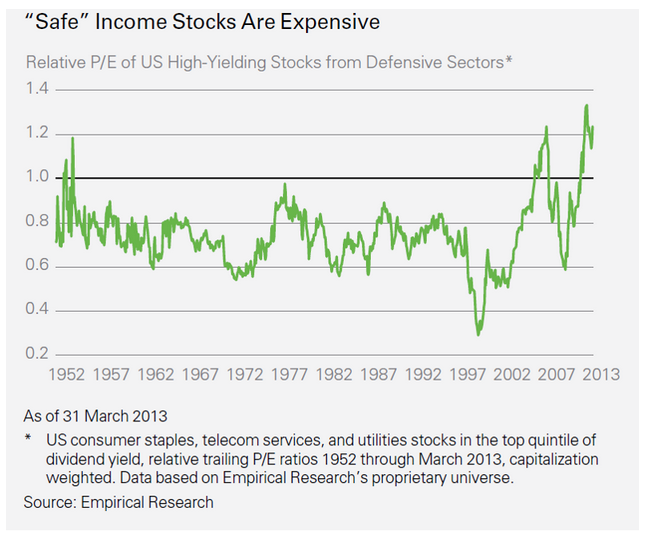
Chart Courtesy: Empirical Research via mebanefaber.com
Tom Lydon’s clients own shares of DVY.