It has been a fine year for mid-cap ETFs. The average year-to-date return for Vanguard Mid-Cap ETF (NYSEArca: VO), iShares Core S&P Mid-Cap ETF (NYSEArca: IJH) and the iShares S&P Mid-Cap 400 Value ETF (NYSEArc: IJJ) is 24.5%.
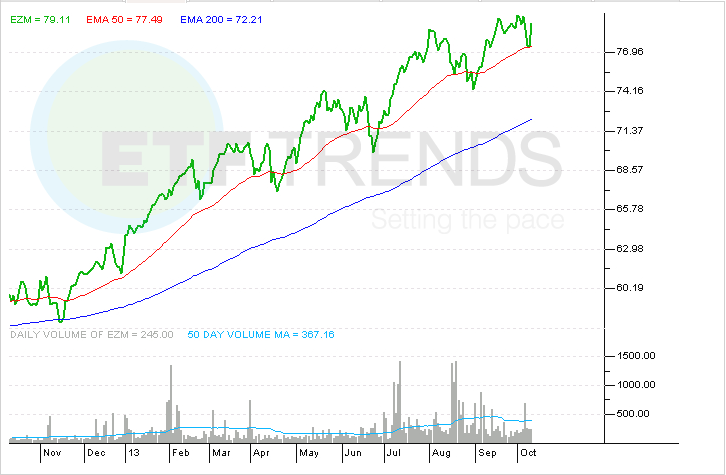
Those are massive ETFs, too. IJJ’s $3.3 billion in assets under management is dwarfed by the $20.1 billion parked in IJH. Yet both of those ETFs along with VB have been outperformed by the far smaller WisdomTree MidCap Earnings Fund (NYSEArca: EZM).
EZM, home to $325 million in assets under management and an expense ratio of 0.38%, is a mid-cap ETF, but it is not a cap-weighted ETF. Rather, EZM is an ETF built on the most important stock evaluation metric: Earnings. EZM focuses on core earnings “computed by Standard & Poors, as the weighting metric. Core Earnings is a standardized calculation of earnings developed by Standard & Poors designed to include expenses, incomes and activities that reflect the actual profitability of an enterprises ongoing operations,” according to WisdomTree.
EZM’s out-performance of its rivals is nothing new. Over the past three years, the fund has outpaced VB and IJJ by an average of 790 basis points while being less volatile than VO and only slightly more volatile than IJJ. [Mid-Cap ETFs: Take Your Pick]
The WisdomTree MidCap Earnings Index’s annualized volatility and beta since inception are only modestly higher than the comparable figures on the S&P MidCap 400 Index, but EZM’s index has outperformed the S&P index by nearly 120 basis points, according to WisdomTree data.
While some see stretched valuations with mid-caps, there are reasons to consider mid-caps, namely tidier balance sheets. Smaller companies are also less leveraged, with U.S. mid-caps holding 46 percent less debt per share than S&P 500 firms, Bloomberg reported.
Additionally, EZM is not too richly valued. The ETF had a P/E of 16.5 and a price-to-book ratio of 1.81 at the end of the second quarter. Those numbers have probably come up a bit, but IJH has a P/E of nearly 27 and a price-to-book ratio of 3.57.
Notably, EZM allocates over 27% of its combined weight to industrial and health care, two of the sectors where mid-caps have been leaders over the past year.
EZM’s largest sector weight is financial services at 21.5%. That is important because small- and mid-cap banks have seen their profits crimped because of low interest rates. The potential upside for EZM is that Federal Reserve tapering has been postponed, not delayed indefinitely. Should tapering reenter the conversation soon and cause another spike in Treasury yields, EZM’s mid-cap bank exposure could prove beneficial. [Too Early to Bank on Regional Bank ETFs]
WisdomTree MidCap Earnings Fund
ETF Trends editorial team contributed to this post.