Small-cap ETFs such as iShares Russell 2000 (NYSEArca: IWM) are beating the S&P 500 this year but there are some signs the category is losing its performance edge.
A trend change could have implications for the overall market. However, it’s not clear that the underperforamnce of small-cap stocks means the rally is in immediate danger.
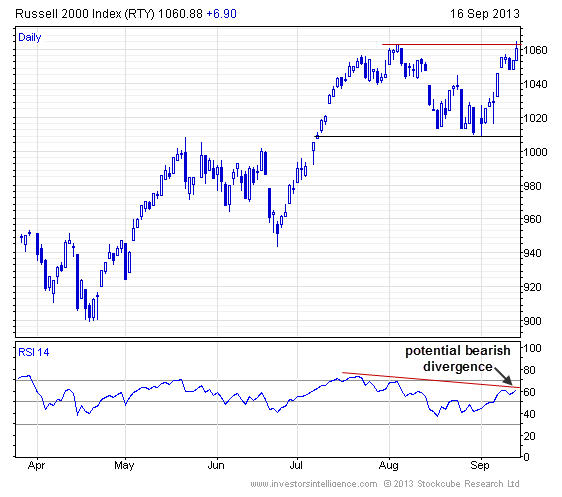
IWM rose to a new all-time high early Monday as stocks rallied on news Larry Summers withdrew his name for consideration as next chairman of the Federal Reserve. However, the small-cap ETF barely posted a gain Monday due to a late-session pullback.
IWM underperformed the S&P 500 on the session, which is not a healthy sign, according to Tarquin Coe, technical analyst at Investors Intelligence.
“With the early August high now tested a large potential bearish momentum divergence exists,” he wrote in a newsletter.
The small-cap Russell 2000 ETF is up 25.5% year to date, compared with a gain of 20.9% for the S&P 500, according to Morningstar.
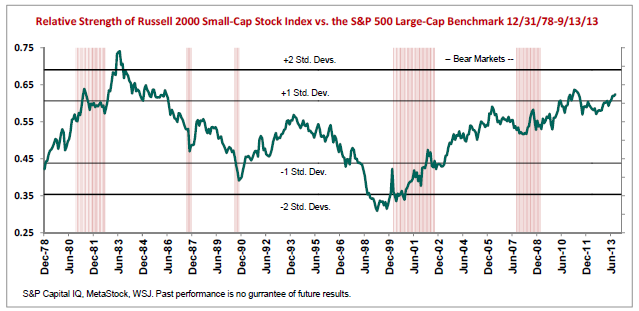
Sam Stovall, chief equity strategist at S&P Capital IQ, was out with a note this week examining if the eventual underperformance of small-cap stocks relative to large-cap issues will signal the end to this bull market.
“In other words, could the performance of small-cap stocks, relative to large-cap issues, act as a canary in the coal mine or early warning signal for an impending bear market? My answer was no, since small-cap stocks have historically beaten large-cap issues during most complete years of bull markets, and actually kept singing during the first two years of the dot-com cave-in,” Stovall wrote.
Next page: ‘Canary in a coal mine’
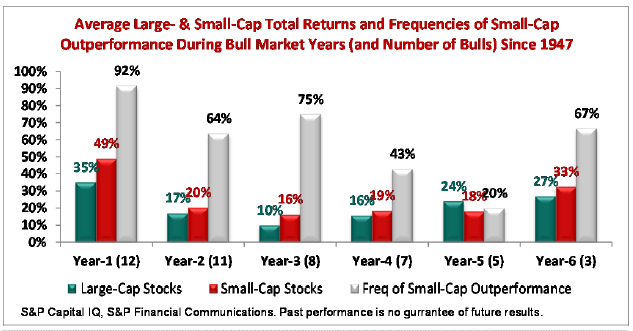
Since 1947, there have been 11 completed bull markets, and investors are currently enjoying the twelfth.
Small-caps tend to outperform the S&P 500 during the first four years of a bull market.
“Year five – the one we are in now … typically saw large caps post higher total returns than small caps, and outpace small caps 80% of the time. This year’s results could change things, however, as the S&P 500 rose 18.4% in price through September 13, while the S&P SmallCap 600 gained 24.9%,” the strategist wrote.
“Should this bull market continue into its sixth year (March 9, 2014-March 9, 2015), then history says, but does not guarantee, that small-caps could see a late-stage surge and outpace large caps once again. Since WWII, only three bull markets completed year six, and small-cap stocks outpaced large ones in two of these three observations,” Stovall added. “As a result, based on full-year bull market performances, small-cap underperformance cannot be used an early-warning signal against an eventual topping of bull markets, in my opinion.”
Based on the duration and magnitude of advance for this small-caps, history would imply that we are probably in the latter innings of small-cap dominance, and it will likely become time for the momentum to shift back into the large cap’s favor, according to S&P.
“Since 1947, the average total return for small-cap stocks has usually exceeded that of large-cap stocks in five of six bull market years,” Stovall concluded. “Only in year five did they traditionally underperform, rising an average 18% to the S&P 500’s 24% gain. So to think that small-cap performances will serve as a canary in a coal mine, signaling with ample foreboding of an impending bear market, is unfounded by my analysis.”
Full disclosure: Tom Lydon’s clients own IWM.