Last week, the yield spread between 2- and 30-year Treasuries reached 342 basis points, its widest on a closing basis since August 2011 and yields on benchmark 10-year Treasury bonds rose over 10 basis points, touching 2.74% Thursday before dropping back to 2.63%. Yields were on the rise again Monday, closing at 2.67%, indicating that concerns linger about rising interest rates.
Supporting that notion are inflows data that indicate investors have been turning to short-duration bond ETFs as a way of coping with rising rates. High-yield corporate bond ETFs, which usually have shorter durations than government bond funds, hauled in $2.6 billion in assets last month, according to inflows data from BlackRock. [Treasury ETFs Soften on Jobless Claims]
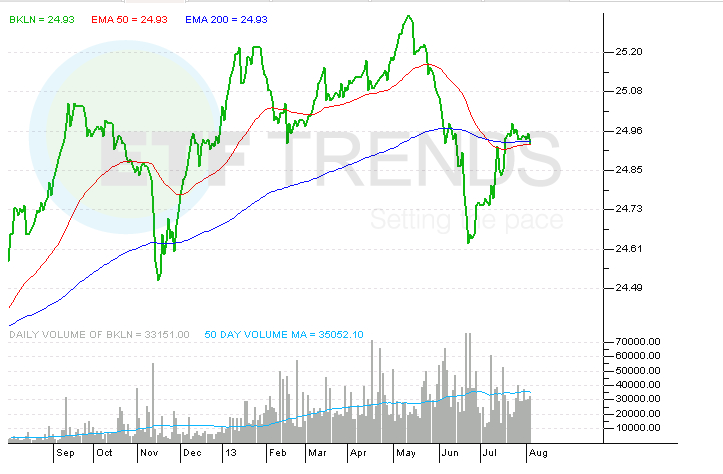
Further cementing short-duration ETFs as the place to be in the fixed income universe are this year’s two most popular bond funds. The Vanguard Short-Term Bond ETF (NYSEArca: BSV) and the PowerShares Senior Loan Portfolio (NYSEArca: BKLN) are the only bond ETFs on the list of this year’s top-10 asset-gathering ETFs. Conversely, four bond funds are on the list of 10 worst outflows. [Short Duration High-Yield Bond ETFs in Sweet Spot]
As of the end of July, BSV had taken in $3.69 billion this year while BKLN, the first ETF offering exposure to senior loans, had attracted $3.49 billion. Duration is the measure of a bond’s sensitivity to interest rate increases and both funds fit the bill as “low duration” plays. BSV has an average duration of 2.7%, meaning the fund should fall 2.7% if interest rates rise 1%.
A combined 88% of BKLN’s 131 holdings are rated BB or B on the Standard & Poor’s ratings scale, indicating BKLN qualifies as a high-yield bond fund. Although there is credit risk associated with junk bonds, investors favored high-yield loans as Treasury yields rose in June. Loans do provide some buffer against rising rates, but in exchange for that protection, investors must accept credit risk. [Bank Loan or Junk Bond ETFs for Yield]
Senior loans, such as those held by BKLN, are debt instruments that due to their senior status, move the holders of these loans to the front of line for some compensation in the event the issuing party declares bankruptcy.
Adding to the allure of senior loan funds beyond their high yields is that these loans have performed well during periods of economic stress. For example, the Credit Suisse Leveraged Loan Index generated positive returns from 2008-2010 even as senior loan default rates reached record highs, according to Invesco data. Senior loan default rates peaked at 10.8% in late 2009, but the historical default rate is around 3%.
PowerShares Senior Loan Portfolio
ETF Trends editorial team contributed to this post. Tom Lydon’s clients own shares of BSV.