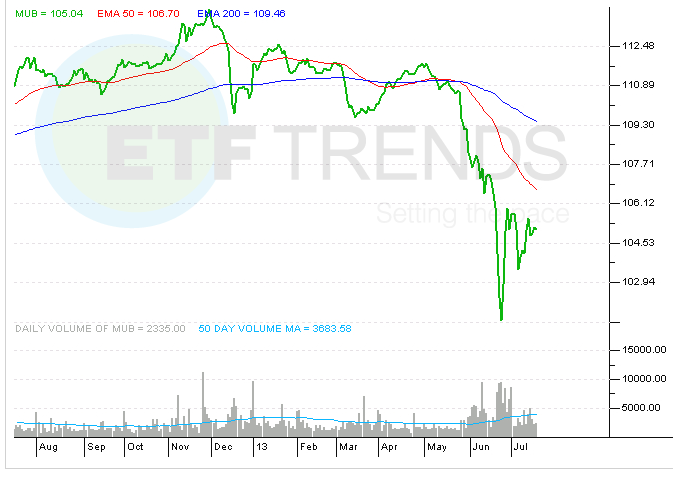
The iShares National AMT-Free Muni Bond ETF (NYSEArca: MUB) was down 0.6% in afternoon trading Friday following news that Detroit has become the largest U.S. city to slip into bankruptcy.
Detroit filed for bankruptcy on Thursday, “setting the stage for a costly court battle with creditors and opening a new chapter in the long struggle to revive the city that was the cradle of the American auto industry,” Reuters reports.
MUB has next to zero exposure to Michigan, but Detroit has heightened concerns over the municipal debt market. [Muni Bond ETFs: Defogging Lenses Required]
“Municipalities have been in a difficult situation since the financial crisis,” writes Morningstar analyst Timothy Strauts in a report on the ETF. “Normally a very docile sector of the market, muni bonds have increased risk because of the budget issues at state and local governments.”
The critical element in the Detroit bankruptcy filing is “that it begins to challenge what has been the foundation for nearly 70% of all financings done in the municipal bond market: the ‘moral obligation’ on the part of the issuer of bonds to adhere to the promise to set the ‘full faith and credit’ and taxing power of the entity ahead of other debts in order to repay the owners of those bonds,” said Jim Colby, senior municipal strategist with Market Vectors ETFs.
“The State-appointed emergency manager has already made representation that he, and the State, may be willing to break that foundation in its effort to save Detroit and put it back on the path to financial solvency,” Colby added. “What is of concern here is that the path chosen for Detroit will set a precedent for other struggling cities and communities that undermines the totality of municipal finance. Should that occur, there would be damage done to untold numbers of portfolios as confidence disappears and valuations drop. The process, to be sure, will not please everyone and pain will be borne. But, caution is urged with regards to any precedent-breaking that leaves a nearly $3.7 trillion industry looking worse than this city in its darkest day.”
Muni bond ETFs have also faced recent bouts of volatility on concerns the asset class may lose its tax advantages.
“In general municipal-bond funds are most suitable for use in taxable accounts by investors in high tax brackets. The reason is that interest income from municipal bonds is tax-exempt at the federal level,” Morningstar’s Strauts explains. [Muni Bond ETFs on the Mend Despite Renewed Tax Worries]
“Over the last week, municipal bonds have been back in the headlines as the city of Detroit, Michigan has declared that it will be unable to make payments on a portion of its debt,” writes David Fabian at Fabian Capital Management. “Their restructuring proposal has asked bond holders to be repaid less than 10 cents on the dollar. While defaults on muni bonds are rare, there have been several high profile instances of insolvent municipalities or debt restructuring demands over the last several years that have shaken investors’ confidence in these securities. In addition, the recent rise in interest rates has caught many fixed-income holders off guard as the price of their bonds has receded.”
iShares National AMT-Free Muni Bond ETF