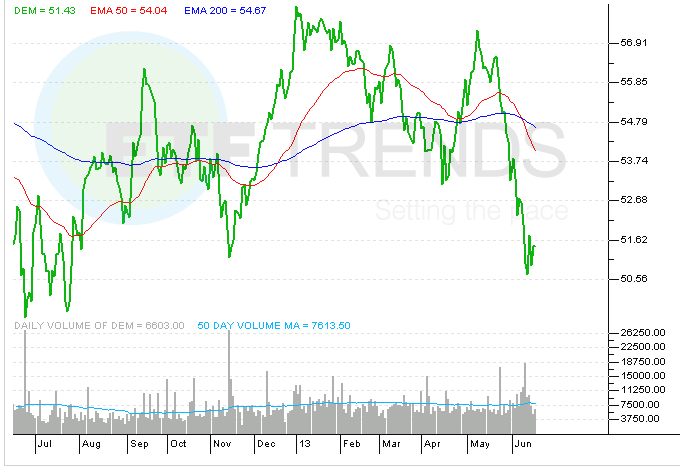
The dividend approach used by WisdomTree Emerging Markets Equity Income (NYSEArca: DEM) has helped it outperform larger rivals but some analysts are worried about the ETF’s rising exposure to Russian stocks.
DEM sports a three-year annualized return of 5.9%, compared with 1.7% for iShares MSCI Emerging Markets (NYSEArca: EEM) and 2.3% for Vanguard FTSE Emerging Markets (NYSEArca: VWO).
VWO is the largest emerging market ETF with $52.2 billion in assets, followed by EEM with $35.2 billion and DEM with $5.1 billion. [Emerging Market ETF Trouncing the Competition]
VWO and EEM weight stocks according to the traditional market-cap approach. Larger stocks get a bigger weighting.
DEM, the WisdomTree ETF, weights stocks by dividends. This strategy results in a different-looking portfolio. This scheme has resulted in outperformance relative to rivals, a quality tilt and lower volatility, says Morningstar analyst Patricia Oey.
DEM rebalances its portfolio annually in June, and the changes will implemented in the ETF at the end of this week.
Oey points out the ETF will again boost its exposure to risky Russian stocks. In last year’s rebalance, Russian stocks rose to 13% of the portfolio, from an average of 2% the prior three years. After this week’s rebalance, Russia will rise to 18% of the ETF’s portfolio, she said.
Next page: Rising volatility
“With DEM’s large allocations in Russian stocks and Chinese banks following its 2012 rebalance, I was concerned that volatility was going to rise, which turned out to be the case,” the analyst writes.
The increasing stake in Russia is due to a ruling announced last year that state-owned firms are to pay at least 25% of net income in dividends, Oey notes.
Russia is lagging in emerging markets this year. Market Vectors Russia ETF (NYSEArca: RSX) is down 13.4% so far in 2013, while EEM is off 10.2%.
Morningstar gives five stars to DEM, its top rating. However, the investment researcher is concerned about the rising exposure to Russia and to the big four state-owned banks in China. The Chinese banks accounted for 13% of the portfolio following the 2012 rebalance and will account for about 10% after this year’s rebalance.
“Not surprisingly, we continue to be concerned about the exposures of this fund and the impact that may have on performance,” Oey said.
WisdomTree Emerging Markets Equity Income
Full disclosure: Tom Lydon’s clients own EEM.