Is the U.S. becoming the next Saudi Arabia in terms of oil production? Maybe not, but thanks to soaring output at shale formations in North Dakota, Texas and other states, U.S. oil output is surging. That could boost the future of returns of some energy ETFs.
In its annual review of the global energy market released Wednesday, BP (NYSE: BP) said U.S. oil production rose by 1 million per days last year, helping trim imports by 930,000 barrels per day. Imports to the U.S., the world’s largest oil consumer, are now a staggering 36% below the 2005, reports Brian Swint for Bloomberg.
Last year, the U.S. pumped 8.9 million barrels per day, an almost 14% increase from 2011, according to BP. North American oil supply is set to grow by 3.9 million barrels per day, as emerging economies are on track to exceed oil product consumption by developed markets this year. [Shale Boom Sparks Energy ETFs]
It is also widely expected that if U.S. production does not exceed imports this year, it will happen in the near future, another factor that could be a boon for the following ETFs.
SPDR S&P Oil & Gas Exploration & Production ETF (NYSEArca: XOP)
The SPDR S&P Oil & Gas Exploration & Production ETF is an almost equal-weight fund that gives investors a different avenue to the energy sector beyond cap-weighted funds. Most energy ETFs that are cap-weighted and focused on U.S. stocks are dominated by Exxon Mobil (NYSE: XOM) and Chevron (NYSE: CVX). Those stocks are found in XOP’s 72-stock lineup, but combine for just 3.1% of the ETF’s weight. [Forbes Favorite ETFs]
Adjusting for its components’ weights, XOP’s average market cap is $20.4 billion, but the median market cap in the ETF is just $3.78 billion, indicating XOP does give investors exposure to plenty of mid- and small-cap names as well. The trade-off there is that XOP has a beta of almost 1.6 against the S&P, according to State Street data.
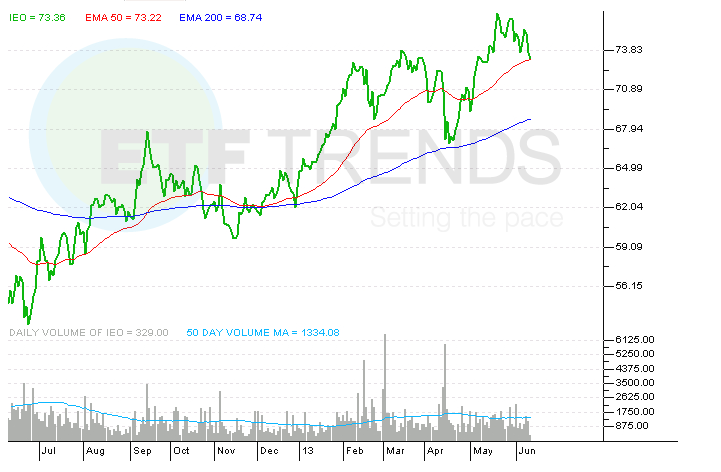
iShares Dow Jones U.S. Oil & Gas Exploration & Production Index Fund (NYSEArca: IEO)
The iShares Dow Jones U.S. Oil & Gas Exploration & Production Index Fund is more focused on large -caps, but has a comparable beta to XOP. Differences between these two funds are noteworthy as IEO is up 32% in the past year while XOP has climbed 27%.
IEO offers a two-fold way for investors to profit from increased North American oil production. First, it is one of just a small number of energy ETFs that feature decent exposure to refining names such as Phillips 66 (NYSE: PSX) and Marathon Petroleum (NYSE: MPC). Second, IEO’s largest holding, Occidental Petroleum (NYSE: OXY), could sell its international operations to boost shareholder value. As it is, the company is a dominant player at California’s Monterey Shale.
On a related noted, Devon Energy (NYSE: DVN) only explores for oil and gas at onshore locations in the U.S. and Canada. Those two stocks combine for 17% of the ETF’s weight.
iShares Dow Jones U.S. Oil & Gas Exploration & Production Index Fund
ETF Trends editorial team contributed to this report. Tom Lydon’s clients own shares of IEO.