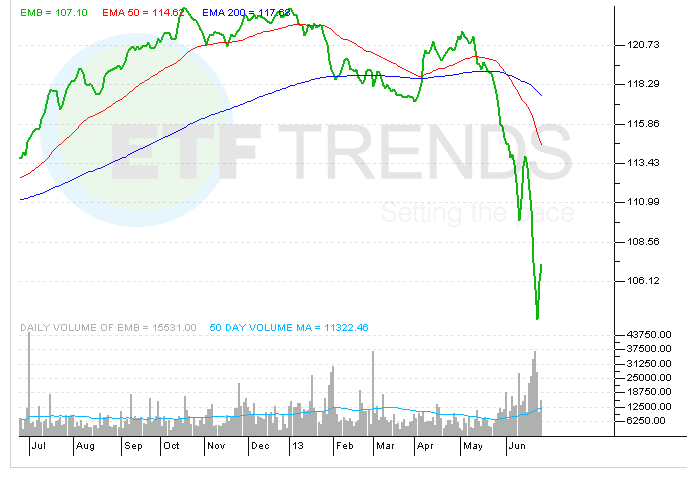
Emerging market bond ETFs have been a popular destination for investors looking for extra yield but the funds have posted steep loses as U.S. Treasury rates rise on Federal Reserve tapering talk.
Developing market debt ETFs are oversold and could be due for a bounce, but some analysts say the long-term fundamental picture is clouded.
“[C]ontinued Fed tapering worries, concerns about rising interest rates in the U.S., and weaker than expected GDP growth for emerging market countries suggest investors should use caution when thinking about investing in emerging market fixed income,” said Todd Rosenbluth, S&P Capital IQ director of ETF research, in a note this week. [EM Corporates Providing No Shelter for ETF Investors]
“Record monetary stimulus emanating from developed market central banks in recent years disproportionately benefited emerging market assets,” he added.
However, now there are signs the Fed could soon pull back from monetary easing. Emerging market sovereign bond spreads over the 10-year U.S. Treasury have widened from 2.5% in January 2013 to above 3.7% in recent days. This move shows bond investors are reining in risk.
“Developing economies are also suffering from homegrown growth challenges ranging from stubbornly high inflation to widening trade deficits and popular unrest,” Rosenbluth added. [No Country for Bond ETF Investors]
Next page: A look at individual emerging market bond ETFs
Rosenbluth also profiled some of the largest ETFs for emerging market bonds:
- iShares Emerging Markets Corporate Bond Fund (NYSEArca: CEMB) seeks to track the price performance of bonds in the Morningstar Emerging Markets Corporate Bond Index. It has $39.6 million in assets, its largest GICS sector exposure is to Financials (24% of assets) and its largest country exposure is to Brazil (14% of assets). CEMB has an average duration of 5.76 years and nearly half of the assets are in bonds with BBB credit ratings and 20% with BB or lower ratings from rating agencies that operate independently from S&P Capital IQ. CEMB also receives an underweight ranking for its Risk Considerations and its Cost Factors. Its expense ratio, at 0.60%, is quite high for a
fixed income ETF, but in line with others, according to S&P. - Market Vectors Emerging Markets Local Currency ETF (NYSEArca: EMLC) seeks to track bonds in the JPMorgan Government Bond Index – Emerging Markets Core issued in local currencies. It has $1.3 billion in assets and its largest country exposure is to Poland (10%). EMLC has an average duration of 4.94 years. EMLC’s credit quality is stronger than CEMB’s, with 30% in bonds rated A and just 11% in bonds rated below B based on S&P Capital IQ data. Some of the advantages of investing in local currencies are that yields that are less volatile and that are higher than equivalent U.S. dollar bonds. EMLC’s S&P Capital IQ technical indicator is negative (bearish). The expense ratio is 0.47%, Rosenbluth said. [Emerging Market Bond ETFs For Yield]
- iShares Emerging Markets High Yield Bond ETF (NYSEArca: EMHY) seeks to track the performance of the Morningstar Emerging Markets High Yield Bond Index, which is made up of all U.S.-dollar denominated bonds. EMHY has nearly $230 million in assets and its largest country weight is Turkey at 16.9%. EMHY has an average duration of 6.08 years. It has a riskier credit profile, with 80% of assets rated BB or below and just 19% rated BBB or above. EMHY is quite expensive at 0.65%, S&P notes.
- iShares Emerging Markets USD Bond ETF (NYSEArca: EMB) tracks bonds in the JPMorgan EMBI Global Core Index, which contains bonds denominated in U.S. dollars. EMB has $5 billion in assets, and its largest country weight is Russia with 6.71%. EMB’s average duration is 7.67 years. EMB has 49% of assets rated BBB, while 36% of assets have a rating of BB or lower. EMB’s expense ratio is 0.60%.
iShares Emerging Markets USD Bond ETF
Tisha Guerrero contributed to this article.
Full disclosure: Tom Lydon’s clients own EMB.