Moderating global growth, sticky inflation and political stagnation negatively impacted the Indian economy in 2012.
Growth decelerated to under 4% while above-trend inflation effectively tied the hands of the RBI.1 The rupee sharply declined against the U.S. dollar last year.
However, in February 2013, we mentioned that the Indian economy may be turning the corner.
As a result of recently announced tax reforms and a fresh round of interest rate cuts from the central bank, we are bullish on the Indian rupee in 2013.
Lower Oil and Gold Permits Easier Monetary Policy
Key commodities that account for a large percentage of the average Indian citizen’s spending have fallen significantly. So far this year, oil is down nearly 6.5% while gold has fallen 12%.2 With lower inflation being reported via the Wholesale Price Index (WPI), the Reserve Bank of India recently cut interest rates to help get economic growth back on track. In fact, the International Monetary Fund (IMF) forecasts that the Indian economy will grow by 5.7% in 2013.3 As a result of lowered borrowing costs and rebounding growth, we believe money may continue to flow into the Indian economy through accelerating foreign direct investment (FDI).
Lower Taxes, More Flows
On April 30, 2013, the Indian Ministry of Finance announced that withholding taxes on government and corporate debt would be cut from 20% to 5% effective June 1. Through lower taxes, the Indian government is attempting to make Indian debt more attractive to foreign investors. Flows from abroad could then give a lift to the rupee, a currency we believe to be undervalued compared to the U.S. dollar. According to the IMF, the Indian rupee is currently undervalued by nearly 62% versus the U.S. dollar.4
Next page: Even with Rate Cuts, Carry Still Attractive
Even with Rate Cuts, Carry Still Attractive
Although the central bank has recently cut interest rates by 0.25% to 7.25%,5 we still believe India provides attractive opportunities for carry. In fact, India still has some of the highest short-term interest rates across all emerging markets. As of March 31, 2013, the “implied yield” of 3-month forward contracts was 7.68%.6 The notion of implied yield means that, should the value of the rupee not change against the U.S. dollar, the return embedded in the forward currency contract would be 7.68% on an annualized basis. For currency investors, this interest rate provides a “cushion” of returns that could potentially mitigate or offset losses, should the rupee depreciate against the U.S. dollar.
Additionally, many currency investors look to a concept known as carry per unit of foreign exchange (fx) volatility. Essentially, this measure attempts to provide a standardized means of comparing risk and reward in currency markets.
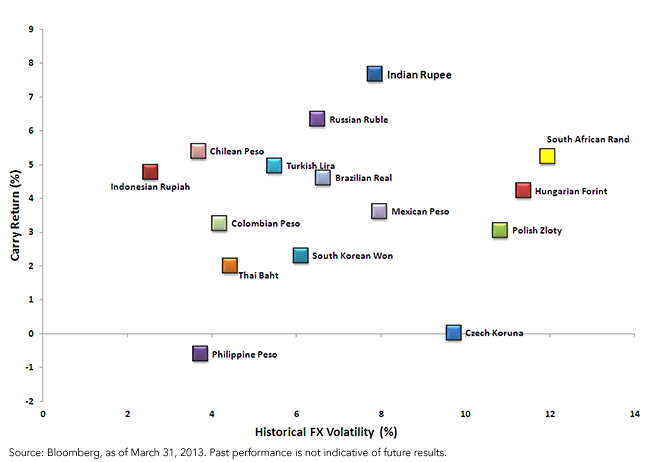
As the chart above shows, the Indian rupee has provided some of the highest implied interest rates of any emerging market country over the past year. However, it has also seen its volatility climb compared to other Asian and Latin American currencies over the past year. Yet when compared to many European or African currencies, the rupee has been comparatively attractive given its higher carry and lower levels of volatility.
Outlook for the Remainder of 2013
If rate cuts and inflows are supplemented by further political reforms, we believe the Indian rupee has the ability to deliver sizable appreciation against the U.S. dollar by the end of the year. Combined with higher local interest rates, investments in the Indian rupee could potentially provide an attractive entry point for investors near current levels.
Rick Harper is head of fixed income and currency for WisdomTree Asset Management. This post was republished with permission from the WisdomTree blog.
1Source: International Monetary Fund (IMF), 2013.
2Source: Bloomberg, 4/30/2013.
3IMF, 2013.
4IMF, 3/31/2013.
5Source: Bloomberg, May 3, 2013
6Source: Bloomberg, 2013