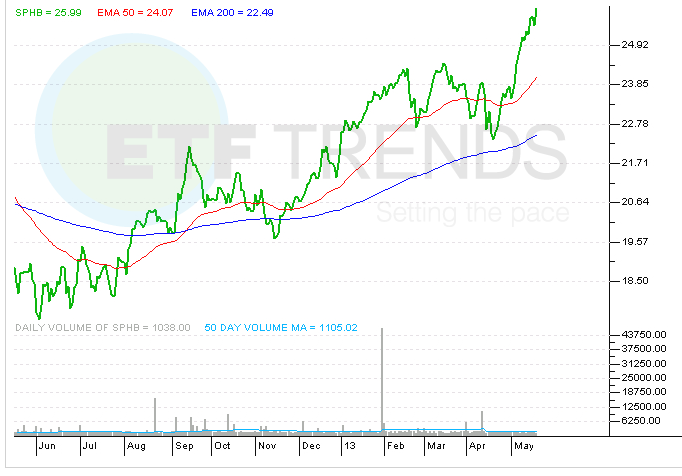
Low-volatility ETFs were outperforming in 2013 until mid-April when cyclical sectors took over the leadership from stable, dividend-paying sectors.
Recently, so-called high-beta ETFs are beating low-volatility strategies.
For example, PowerShares S&P 500 High Beta (NYSEArca: SPHB) is up 15.3% the past month to nearly double the 7.7% gain posted by the S&P 500, according to Morningstar. [Are High-Beta Funds the Next Low-Volatility ETFs?]
PowerShares S&P 500 Low Volatility (NYSEArca: SPLV) has delivered a total return of just 3.8% over the same period. A major headwind has been the lagging performance of utilities, the worst-performing sector since mid-April. The low-volatility ETF has 28.6% in utilities, its largest sector allocation. [ETF Chart of the Day: Utilities Sector]
Beta is a measure of how closely correlated a stock’s returns are to that of the market. The market has a beta of 1.0, and stocks with a beta of more than 1.0 are more volatile than the market. Conversely, SPLV consists of the 100 stocks from the S&P 500 with the lowest realized volatility over the past 12 months.
Next page: High-beta ‘poised to pop?’
One possible reason for the outperformance of low-volatility ETFs in the first few months of the year was that income-starved investors were attracted to conservative sectors that tend to pay higher dividend yields, according to Sam Stovall, chief equity strategist at S&P Capital IQ. [High-Beta or Low-Volatility ETFs?]
However, investors over the past month have been favoring riskier, cyclical sectors such as tech, materials and energy.
Stovall notes that high-beta stocks outperformed low-volatility during the go-go 1990s. That trend flipped during the first 13 years of the new millennium when “fortune did not smile as favorably on high-beta as before,” the strategist said.
Now, investors are wondering whether the S&P 500 has yet again entered into a new secular bull market and if high-beta stocks are “poised to pop” and regain their relative outperformance position, Stovall wrote in a note Monday.
S&P Capital IQ said momentum is now on the side of high-beta. “It appears to us that high-beta is bouncing back,” Stovall concluded. “The only question is for how long.”
PowerShares S&P 500 High Beta