Junk bond ETFs such as the iShares iBoxx $ High Yield Corporate Bond Fund (NYSEArca: HYG) and the PIMCO 0-5 Year High Yield Corp Bond Index ETF (NYSEArca: HYS) hauled in about $10 billion in new investments last year, but that placed slowed to $1 billion through the first four months of 2013, according to recent research from S&P Capital IQ.
That is not a bad four-month tally, but one area of the high-yield bond ETF universe that has seen stellar inflows in 2013 is bank loan ETFs.
One reason for the soaring popularity of senior bank loan ETFs is the buffer these funds offer should interest rates rise. While it doesn’t look like interest rates will budge anytime soon, rates will not stay at these historically low levels forever. [Bank Loan, Floating Rate ETFs For Rising Rates]
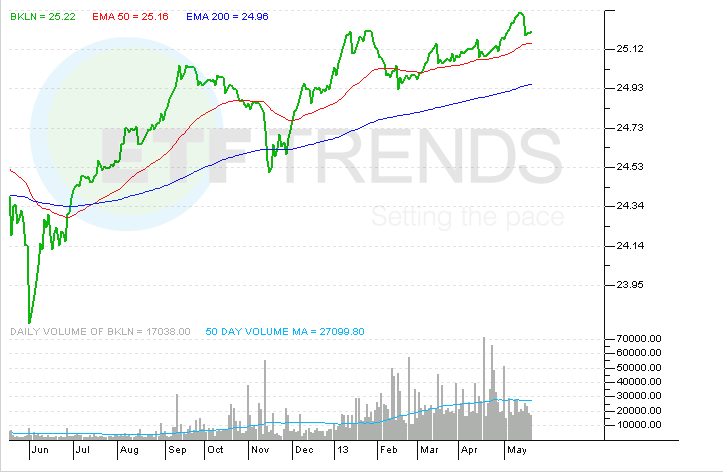
A case can be made that either preparation for or the expectation of rising rates have bolstered the popularity of ETFs such as the PowerShares Senior Loan Portfolio (NYSEArca: BKLN). While traditional junk bond ETFs such as HYG and HYS raked in “just” $1 billion in inflows through the first four months of this year, BKLN, the original senior loan ETF, has attracted $2.75 billion in assets, according to PowerShares data.
That is nearly twice as much as the second-best PowerShares ETF in terms of year-to-date inflows, the wildly popular PowerShares S&P 500 Low Volatility Portfolio (NYSEArca: SPLV), which has drawn in over $1.5 billion in new assets.
Next page: More bank loan ETFs
BKLN now has $4.28 billion in assets under management. The ETF’s success along with today’s low interest rate environment have combined to be a perfect storm of sorts that has fostered increased competition in a previously empty and opaque corner of the ETF universe. [Bank Loan ETFs: More Competition In A Red Hot Sector]
For example, two new actively managed senior loan ETFs have debuted this year and both are off to fine starts, underscoring investors’ willingness to shift from traditional high-yield fare to bank loans. The SPDR Blackstone / GSO Senior Loan ETF (NYSEArca: SRLN) is not even two months old yet and already has more than $203 million in assets. The First Trust Senior Loan Fund (NasdaqGM: FTSL) launched earlier this month and already has nearly $25 million in assets.
As insulation against rising rates, FTSL looks particularly compelling with a weighted average effective duration of just 0.64 years, according to issuer data. The floating rate feature found in bank loan ETFs is another source of allure for investors.
“A key characteristic of senior loans is their floating rate feature, which resets generally every 30 – 90 days based on prevailing short-term interest rates. It is this resetting feature that has the potential to provide protection in a rising interest rate environment,” said Illinois-based First Trust.
Fortunately, the proof is in the pudding regarding the protection bank loan ETFs offer against rising rates. Assuming a 1% increase in interest rates, the S&P/LSTA U.S. Leveraged Loan 100 Index, the index tracked by BKLN, would still generate positive returns. However, indexes tracking everything from medium-term Treasurys to municipal bonds to dollar-denominated emerging markets sovereign debt would offer negative returns, according to First Trust data.
ETF Trends editorial team contributed to this story.
Full disclosure: Tom Lydon’s clients own HYG.