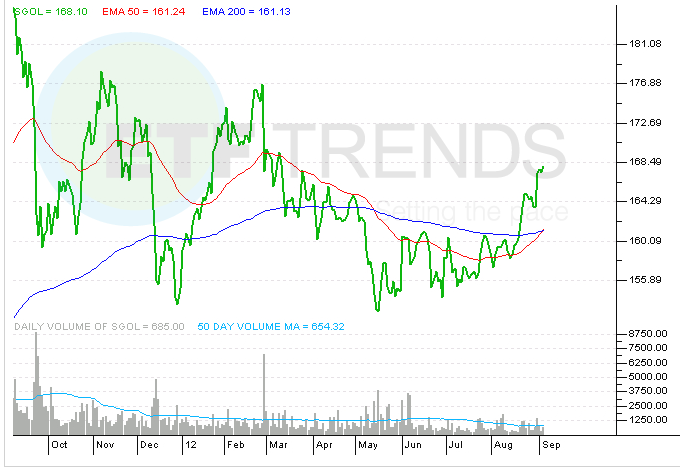
Since mid-July the gold price has rallied strongly, but remains 11% below the peak of USD$1900/oz. achieved in September 2011.
European financial and economic turmoil continues to plague financial markets, yet officials have so far failed to find a comprehensive plan to solve the root causes of the crisis. Europe remains mired in deep recession, the US economy appears to have stalled, while Asian emerging market growth has slowed. In this environment most “safe haven” assets have performed well, with G-3 bond yields falling to all-time lows earlier this year. Prior to August, the stand-out exception was gold, which had performed relatively poorly in 2012.
Gold’s modest performance in an environment of high sovereign risk caused some investors to question its historic “store of value” credentials. In this note we look at some of the key factors that traditionally drive gold price performance, explain what has been behind the performance of the gold price so far this year, and assess the outlook and likely key catalysts for gold price performance for the rest of 2012 and into 2013.
Summary
In recent months, it has become increasingly clear that another round of quantitative easing (QE) from the US Federal Reserve (Fed) is a potential catalyst that precious metal investors are waiting for – both for US dollar weakness and gold price performance. The gold price has tended to move higher when weak data or statements from the Fed indicate that another round of quantitative easing may be coming and vice versa. US employment and growth data have become key barometers of the likelihood of further Fed easing as the Fed has made clear that with inflation now under control, its focus is increasingly skewed towards the second objective of its double mandate – job creation. The US needs employment growth of 100,000 just to maintain “stability” in the job market. The indication from the recent Fed statements and speeches is that consistent non-farm payroll numbers below 150,000 are likely to trigger another round of QE. If non-farm payrolls and other growth indicators such as the monthly ISM manufacturing surveys do not start to show substantial and sustainable improvement, a new round of QE seems increasingly likely. With some form of QE3 getting closer and Europe financial and sovereign risks still high, there are good reasons to believe the gold price has the potential to move higher in the coming months.
Gold Price Drivers and Recent Performance
Historically, gold has tended to perform best during periods of low real interest rates and high monetary expansion, as they are often associated with currency debasement and systemic financial failures. The demand for gold has tended to move inversely to real interest rates due to the reduced opportunity cost of holding gold versus interest-bearing investments and its inflation hedge properties. With governments around the world having to contend with weak economic growth, and structurally burdened by the need for multiple years of deleveraging from both public and private sectors, real interest rates have been pushed to exceptionally low levels.
Most central banks have adopted an expansionary monetary policy to support growth and financial systems. This has provided a foundation of support to the gold price. The Federal has more than tripled the US base money supply through two rounds of quantitative easing, raising concerns about the future real purchasing power of the US dollar, increasing demand for gold as a hedge.
Another factor that is providing fundamental underlying support to the gold price is the dramatic switch of central banks from net sellers to net buyers of gold. As Figure 3 shows, up until 2009 central banks were large net sellers of gold, often comprising up to 15% of total annual gold supply.
Since 2010 central banks have become large net buyers of gold, equivalent to around 10% of total supply. This shift is highly significant, representing a nearly 25 percentage point impact on gold’s supply-demand balance. Most of this buying is by emerging market central banks reducing their very heavy exposure to the US dollar and the Euro.
Given the large and growing debt and fiscal issues facing both Europe and the US, it is likely that this trend will remain in place for the foreseeable future and continue to provide underlying support to the gold price.
Gold has traditionally been considered a hedge against financial risk due to its low correlation with major equity markets and risky assets over time.
However, since the end of the second round of quantitative easing on June 30 2011, the positive correlation between the gold price and risk, as measured by the VIX index, began to fall, turning negative in October 2011. The reversal of the correlation between gold and financial risk is also evident when looking at the relationship between the gold price and Spanish credit default swap (CDS) spreads. Since the end of last year, Spain’s bond spreads have surged as growing concerns about Spain’s banking system and fiscal profile caused investors to reduce exposure to Spanish sovereign bonds. Despite the rise in sovereign risk, gold price performance has been lackluster.
Why has gold not been benefiting more from such negative sentiment? As we describe in more detail in the next section, the strength of the US dollar has likely been a key factor dampening the gold price’s reaction to rising risk and quantitative easing remains a crucial driver of both US dollar and gold price performance.
Gold and the US Dollar
The gold price has traditionally tended to be negatively correlated to the US dollar, highlighting gold’s value as a hedge against structural US dollar weakness. The elevated level of risk and uncertainty that has led to investors’ deleveraging has forced the US dollar higher and played a key role in hampering the performance of gold since September 2011, making it less positively correlated to systemic risk in Europe. Growing investor concerns about the potential implications of a disorderly exit of Greece from the Euro, and of Spain and Italy’s growing problems, spurred investors’ demand for “safe haven” G3 bonds (US Treasuries, JGBs and Bunds) sending yields to all-time lows in June 2012.
While one would intuitively expect that this would also benefit gold, the gold price was on a general declining trend during this period. A key reason for this is that with the stress focused on Europe, the increased risk perception also pushed up the US dollar versus the Euro, triggering selling of gold by short-term investors. In other words the European crisis has been enough to spark Euro weakness, but has not yet become severe enough to trigger fears of an imminent Euro Area breakup and force capital flows into gold.
The Gold ‘Bubble’ and Investor Dynamics
Suggestions that gold is in a bubble are worth exploring because of the potential implications for investors. If the current trajectory of the gold price is mapped against previous instances of bubble formation, gold appears to be continuing a gradual uptrend rather than exhibiting bubble characteristics.
Comparing gold performance over the past 10 years to the tech stock bubble, which peaked in 2000, and to the previous gold bubble of the early 1980’s, shows that the current price of gold remains at levels around one-third the magnitude of previous bubble events. This analysis suggests gold has more room to move and with further central bank stimulus broadly expected by the investment community, how are investors currently positioned?
Gold Exchange Traded Product holdings have increased substantially in recent months, rising to a record level of 79mn ounces in August as strategic investors have taken the view that gold in the current price range represents a good level for accumulation. Futures investors by contrast have tended to be far more momentum oriented, tending to buy when the gold price is rising and selling when the gold price is falling. Excluding the multi-year lows in net long gold futures positions seen in 2012, in our view it is significant that net long positions in gold futures are still hovering at the lowest levels since April 2009. With net long positions still over 50% below the peaks of 2011, it appears there is a potential for a further rebound in positioning if fundamentals turn positive for gold and price momentum attracts additional interest.
Conclusions
The recent behavior of the gold price has caused some investors to question gold’s “safe-haven” properties. A deepening crisis in Europe and uncertainty about the likelihood and timing of another round of quantitative easing by the US Fed have pushed investors to the sidelines, with cash and G-3 bonds the primary beneficiaries. Investor deleveraging and capital flight from the Euro has forced the US dollar higher, dampening gold’s sensitivity to systemic risk and hampering its performance since September 2011.
However, with “operation twist” coming to an end in the next few months, US employment data indicating a stagnating US labor market and Europe’s politicians still far from a comprehensive solution to the region’s problems, the likelihood of another round of US quantitative easing is increasing. While the rising expectation of another round of QE3 is the most likely catalyst for the next leg of the gold bull market, the lower probability, but high impact risk of a full-blown Euro crisis could also be a catalyst for the gold price to break higher.
ETFS Physical Swiss Gold Shares (NYSEArca: SGOL)