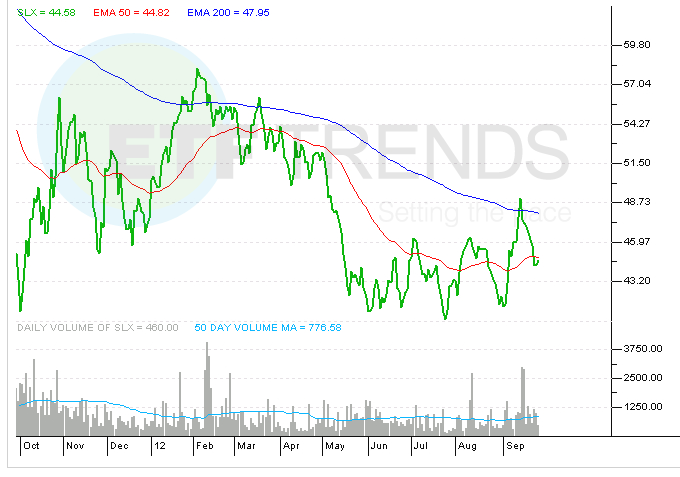
Market Vectors Steel ETF (NYSEArca: SLX) is down 6% year to date on global oversupply of the commodity and concerns over China’s slowing economy.
“Analysts have a dismal outlook for the industry for the remainder of the year despite China’s stealth building plans and global central banks printing money,” reports Trang Ho at Investor’s Business Daily.
The steel ETF has been struggling for a long time. SLX has a red five-year annualized return of -9%, according to Morningstar.
The fund holds assets of $131.4 million and charges an expense ratio of 0.55%. It tracks an index comprised of publicly traded companies predominantly involved in the production of steel products or mining and processing of iron ore.
“This ETF even could appeal to investors who are bullish on long-term growth in hot spots like China, India, and Brazil and want to find a way to indirectly invest in local growth,” says Morningstar analyst Robert Goldsborough. “Growth in China has had a major impact on steelmakers in recent years. China is a top steel consumer, and with the rapid growth of the Chinese economy, steelmakers have benefited.”
However, growth in China has slowed and the steel industry has also been hurt by the debt crisis in Europe and oversupply issues, he added.
PowerShares Global Steel Portfolio (NasdaqGM: PSTL) is another ETF for the sector – it holds only $2 million in assets.
Stainless steel is the worst-performing commodity in the third quarter with a 12% loss. “The usual culprit — slowing growth and excess supply in China,” Investor’s Business Daily reports.
“As long as China, with nearly half of the world’s steel production, is hovering at cost, the rest of the world will struggle to push beyond those levels. Furthermore, weakening end-market demand in China has led to falling steel production there, which led to falling raw material prices, which only pushed finished steel prices lower,” said Paul Robinson, senior economist at market research firm IHS, in the article.
Market Vectors Steel ETF