Assets in junk bond ETFs have soared to over $30 billion as investors move into speculative grade corporate debt in search of more yield in a low-interest-rate environment.
In fact, ETFs are on track to overtake credit derivatives as a way to speculate on high-yield bonds, Bloomberg News reports. Tighter regulation in derivatives markets after the financial crisis is also driving the junk bond ETF boom.
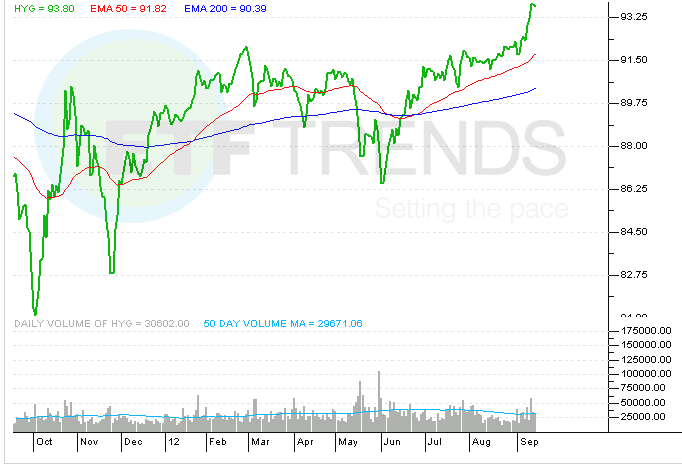
High-yield ETFs are breaking out to new 52-week highs in the wake of the Federal Reserve’s QE3 program while U.S. Treasury funds are staggering as investors take on more risk and move away from safe havens. [High-Yield ETFs Climb to New Highs as Treasuries Languish]
For example, the average junk-bond yield has fallen to all-time lows. [Junk Bond ETFs Break Out as Yields Hit Record Low]
Junk bond ETFs include SPDR Barclays Capital High Yield Bond (NYSEArca: JNK), iShares iBoxx High Yield Corporate Bond (NYSEArca: HYG), PIMCO 0-5 Year High Yield Corporate Bond Index Fund (NYSEArca: HYS) and PowerShares High Yield Corporate Bond Portfolio (NYSEArca: PHB).
JNK and HYG are the largest ETFs in the category and are offering yields around 6%.
“The value of corporate securities held by the five-largest junk ETFs almost doubled in the past year to a record $31.4 billion, while the net amount of protection bought or sold on the debt using the two current credit-default swaps indexes declined 3%to $35 billion,” Bloomberg reports.
The ETFs are growing at an average 5.2% monthly pace this year, which would put assets at more than $36.5 billion by year-end, according to the article.
“Product innovation is often the answer to regulatory change and I don’t think it’s any coincidence that we’ve seen this explosion of interest in fixed-income ETFs just at the point at which CDS as a product and asset class comes under pressure,” Will Rhode, director of fixed-income at research firm Tabb Group, told Bloomberg News.
iShares iBoxx High Yield Corporate Bond
Full disclosure: Tom Lydon’s clients own HYG and JNK.