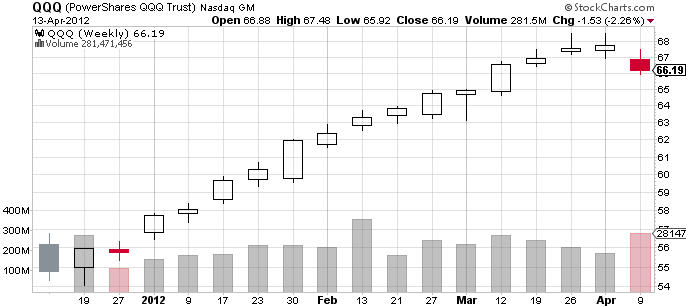
Investors pulled over a half billion dollars from a popular ETF tracking the Nasdaq-100 Index as the fund suffered its first weekly loss of the year after a 14-week string of gains.
In a volatile week that began with heavy selling pressure met by mid-week buying, the S&P 500 hovered around key near term support levels, finally closing at 1370.26 on Friday. Our market technician David Chojnacki pointed out in a note to trading clients last Friday morning that the SPX has near term support in the 1370-1374 level but there is overhead resistance between 1385-1388 as well as 1397-1400.
Additionally, the SPX dipped below its 50 day moving average on several occasions last week for the first time since early December of 2011, and ultimately closed below this level (currently 1375.71) on Friday. Volumes were reasonably heavy throughout the week in broad-based equity products as well as those in other asset classes including commodities and fixed income, as it appears that institutional players were in full participation in the markets last week following the Easter holiday weekend. Earnings season kicked off earlier in the week, and not only were market technicals in focus but clearly fundamentals in terms of earnings hits and misses were fueling much of the volatility last week. The VIX closed at 19.55 on Friday, after trading as high as 21.06 earlier in the week and it has registered 5 consecutive trading sessions above its 50 day moving average now.
From a fund flows standpoint, iShares Barclays 20+ Year Treasury (NYSEArca: TLT) was the leader in the ETF space, reeling in more than $400 million in new assets, and the fund itself has risen nearly 6% in the past 7 trading sessions and is now trading above both its 200 and 50 day moving averages.
Readers will likely recall that we have spent a great deal of time discussing large fund outflows in TLT that began in early March and a “pile on” by bearish speculators via TLT puts and calls in ProShares UltraShort 20+ Year Treasury (NYSEArca: TBT), but the fund has bounced on several occasions at its 200 day moving average since March. Last week, with equities sputtering, longer dated U.S. Treasury bonds caught a bid throughout the week and prices rallied significantly (and thus yields fell).
This, coupled with the rising VIX last week, certainly demonstrates some concern among institutional investors in terms of the staying power of 2012’s equity rally. The recent action in TLT and generally in the U.S. Treasury market has us recalling the price action in the Euro last December, when the currency briefly traded with a $1.26 handle.
We saw short interest via Euro options and futures at a 5 year high, and a flood of put buying in CurrencyShares Euro Trust (NYSEArca: FXE) and call buying in ProShares UltraShort Euro (NYSEArca: EUO), and this actually marked a capitulation point and a significant reversal as the Euro took a leg up since those lows and is notably higher now, 4 months later.
Similarly in TLT, short interest has been building massively in 2012 and shorts have been gaining exposure via futures in long term treasuries, and as TLT put buyers and TBT call buyers continued to pile on when TLT finally “cracked” in early March, this was met by technical support at the 200 day moving average in the ETF. It almost feels like shorts have been getting stopped out of positions on the recent TLT upswing, and this has added fuel to the recent buying pressure in the longer dated treasury bond space.
Several other fixed income ETFs also ranked high on the list of weekly creations, including SPDR Barclays Capital Short Term Corporate Bond (NYSEArca: SCPB) which took in more than $240 million and iShares Barclays 1-3 Year Treasury Bond (NYSEArca: SHY) accumulated about $170 million.
All in all, it was a light week in terms of ETF creations, as we mentioned, TLT was the leader with only $400 million, and in a normal week it is certainly feasible to see one, if not several ETFs pull in more than $1 billion apiece. On the redemptions side of the equation, SPY lost more than $2.5 billion in assets, followed by SPDR Dow Jones Industrial Average (NYSEArca: DIA) (-$580 million), the Nasdaq-100 PowerShares QQQ (NasdaqGM: QQQ) (-$550 million), iShares MSCI Emerging Markets (NYSEArca: EEM) (-$550 million) and SPDR High Yield Bond (NYSEArca: JNK) (-360 million).
Going into this week, fundamentals are still top of mind as we wade through earnings season, and the equity markets are flirting with delicate technical levels at the moment so near term activity could be very pivotal in determining if we have another summer that resembled that of 2011.
The Nasdaq-100 ETF lost more than 2% last week.
Nasdaq-100 PowerShares QQQ (Weekly Chart)
For more information on Street One ETF research and ETF trade execution/liquidity services, contact pweisbruch@streetonefinancial.com.