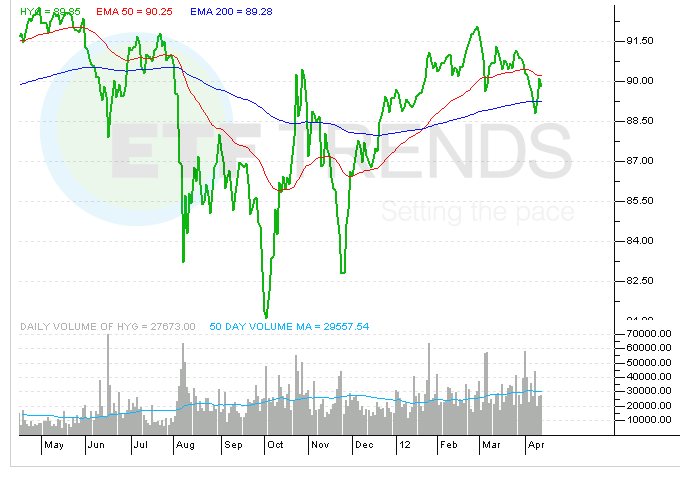
The introduction of junk bond ETFs such as iShares iBoxx High Yield Fund (NYSEArca: HYG) has brought liquidity, transparency and access to a market that was previously inaccessible to many investors, says money manager BlackRock.
HYG and other funds have “effectively changed how investors look at and invest in the high yield market, giving them an intra-day indicator of what the high yield market is doing,” says Matt Tucker, head of fixed-income investment strategy at iShares.
The BlackRock-managed fund is the largest high-yield ETF with $14.2 billion in assets, followed by others such as SPDR Barclays High Yield Bond (NYSEArca: JNK), PowerShares High Yield Corporate (NYSEArca: PHB) and PIMCO 0-5 Year High Yield Corporate Bond (NYSEArca: HYS).
ETFs that invest in high-yield corporate bonds have been a favorite among income-hungry investors. Junk bond mutual funds and ETFs saw their first outflow in 19 weeks. [Investors Cool on High-Yield Bond ETFs]
HYG is the oldest ETF in the category with a five-year track record.
Tucker said although HYG faced questions about its liquidity when it launched in 2007, the fund has actually became a source of liquidity that hadn’t existed before.
“From its launch, investors saw it as a way to gain diversified access to the high yield market through the exchange,” he wrote at the iShares blog.
Including the 0.50% expense ratio, the fund has tracked its index within 0.01% since inception.
“But the big moment for HYG actually came during the financial crisis of 2008. During this period over-the-counter trading was impaired, and many investors began to turn to HYG as a way of accessing the high yield market,” Tucker said. “Despite periods of illiquidity in the OTC market, the ETF structure allows investors to trade high yield throughout the day on the exchange.”
There are 13 high-yield ETFs with a collective $28 billion in assets under management.
iShares iBoxx High Yield Fund