As yields on traditionally safe Treasury bonds hover around historic lows, investors have turned to high-yield exchange traded funds to meet their income needs. However, industry observers caution that the returns may not perfectly reflect the ETFs’ benchmark indices.
Some observers believe that high trading costs and market inefficiencies could cause high-yield ETF returns to be lower than their mainstream high-yield bond index counterparts, reports Steve Johnson for the Financial Times. [High-Yield ETFs for Investors Seeking Income]
“Bonds go in and out of the high-yield benchmarks far more often than stocks go into and out of the S&P 500, so ETF managers are forced to trade more in the high-yield bonds that make up the index,” Douglas Peebles, chief investment officer at Alliance Bernstein, said in the article.
“Virtually all trading in fixed income is done off exchange and pricing in the junk bond market is relatively opaque, which gets reflected in bid/offer spreads,” Peter Sleep, portfolio manager at Seven Investment Management, said in FT report. “However, the benchmark indices do not reflect these frictional costs and so are hard to beat.”
Lipper data reveals that the average high-yield ETF has underperformed its index by 0.46% a month over the past five years, or 5.52% per year.
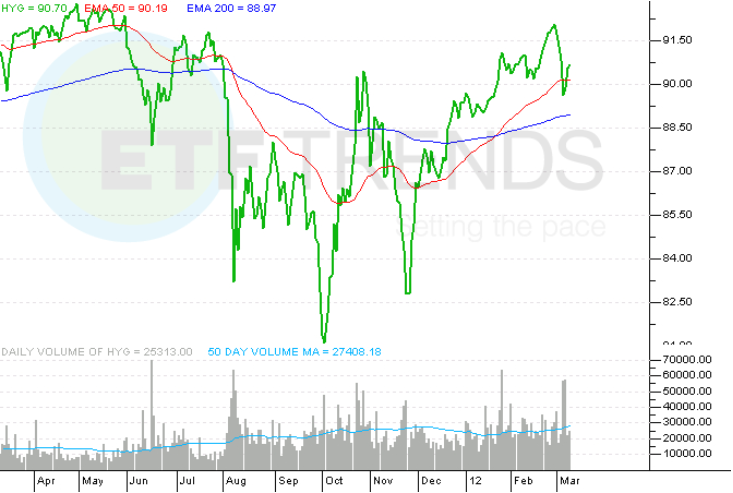
According to BlackRock, high-yield ETFs have brought in $6.6 billion so far this year, compared to $8.4 billion over 2011. The iShares iBoxx $ HY Corp Bond Fund ETF (NYSEArca: HYG) saw inflows of $3.1 billion year-to-date and the SPDR Barclays Capital High Yield Bond ETF (NYSEArca: JNK) attracted $2.6 billion. [ETF Spotlight: High-Yield Corporate Bonds]
JNK has provided annualized returns of 7.0% since 2007, compared to the 10.3% return of the Barclays Capital High Yield Very Liquid Index. HYG has shown annualized returns of 19.9% over the past three years, compared to 27.8% of the Barclays Capital Index. [Bond ETF Assets Rise Nearly 40% in a Year]
Brian Kinney, global head of fixed income beta solutions at State Street Global Advisors, which manages the SPDR ETF suite, contends that the ETFs underperformed in 2009 when the market rallied 40%.
“Over full investment cycles, indices that notionally do similar things will have similar performances,” Alex Claringbull, senior fixed income portfolio manager at BlackRock, parent company of iShares, said in the article.
iShares iBoxx $ High Yield Corp Bond Fund
For more information on high-yield debt, visit our high-yield bonds category.
Max Chen contributed to this article.