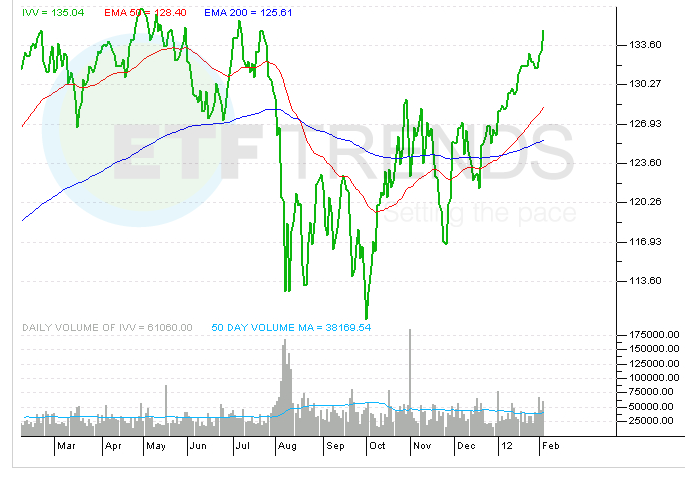
Nearly $30 billion flowed into exchange traded funds last month, but ETF trading volume declined significantly. Analysts are debating whether lower ETF volume is a bullish or bearish sign for the stock market.
ETFs saw net inflows of $29 billion in January, the best first month on record. [ETFs Rake in Cash]
However, daily volume in the 50 most-traded ETFs listed in the U.S. fell to the lowest levels since 2007 in January. [How Lower Trading Volume Impacts ETF Investors]
Last month, total monthly ETF turnover declined by 13%n from December to $1.1 trillion, according to Deutsche Bank.
“U.S. exchange traded product trading made up 26.9% of all U.S. cash equity trading in January, down from both its recent peak of 37.5% last August and its 3-year monthly average of 30.9%,” the bank said in a note Monday.
Overall trading in the stock market is also down in 2012 despite the rally.
“The bullish theory is the simple assumption that the lack of volume thus far means there’s still a truckload of ‘cash on the sidelines’ ready to flood the market and send it rocketing higher. The bearish interpretation is that any money that was available (and was going to be invested) has already been placed, and there just isn’t any more waiting to go to work. Thus, what little strength we’ve seen in stocks so far is now going to be winding down,” writes James Brumley at Investor Place.
“But there’s even a third theory, and it suggests that the continued growth of the ETF industry has quietly garnered all this alleged ‘cash on the sidelines.’ Like with the bearish theory, this means that cash is already in the market and can’t be used to buy again,” he added. [Many Remain Underinvested as Stock ETFs Rise]
iShares S&P 500 (NYSEArca: IVV)