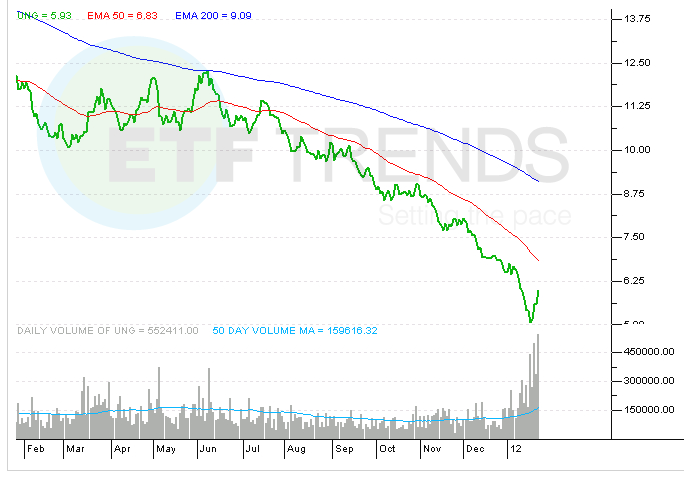
The natural gas exchange traded fund has made an impressive rebound off its recent lows. However, with the U.S. pledging to nurture the nascent shale fracking industry, coupled with warmer weather conditions, natural gas prices could tumble to a 10-year low, analyst say.
U.S. Natural Gas Fund (NYSEArca: UNG) was up 6.6% at last check Wednesday. The fund has gained about 16% since the end of last week, but weakened in Thursday’s action. [Natural Gas ETFs: Rebound or Another Head Fake?]
Natural gas futures were 6.2% higher at last check Wednesday, trading at $2.7 per million British thermal units (Btu).
Despite the short-term gains, fundamental factors could still keep a lid on natural gas prices.
According to Bank of America, Barclays Capital and Prestige Economics, prices may drop below $2 per million Btu for the first time since 2002 on the prospects of inventory levels exceeding storage capacity as the U.S. develops its shale industry, reports Christine Buurma for Bloomberg.
Bank of America projects that inventories will be 2.15 million cubic feet at the end of March, a record high for that period of the year due to the unseasonably warmer winter months.
“If we exit the winter with such high levels of inventories, there’s a real risk of gas prices coming down very sharply in the fall,” Francisco Blanch, the head of commodities research at Bank of America, said.
Gas production expanded by a record 4.5 billion cubic feet per day in 2011, whereas demand fell behind at 920 million cubic feet. U.S. natural-gas production averaged 1.89 trillion cubic feet per month through October, or 13% higher than the average between 2000 to 2008.
“We have a supply of natural gas that can last America nearly 100 years, and my administration will take every possible action to safely develop this energy,” President Obama said at the State of the Union address Tuesday, according to Bloomberg.
U.S. Natural Gas Fund
For more information on natural gas, visit our natural gas category.
Max Chen contributed to this article.
Full disclosure: Tom Lydon’s clients own UNG.