Many investors are unable to understand why markets have shed last year’s volatile swings and are trending steadily higher so far in 2012.
It’s worth asking if the crowd is right to distrust the rally, or if a legitimate change has taken place underneath the market’s surface. Europe is still going through a recession and we could be headed for Lehman 2.0 still, right? The bond market remains near panic yield levels, meaning that markets have to decline as a result, correct? [Treasury ETFs on the Precipice]
The problem I have with that thinking is the automatic assumption that the bond market is always right. Yes, the bond market is generally more right than the stock market, but this does not mean it’s always right.
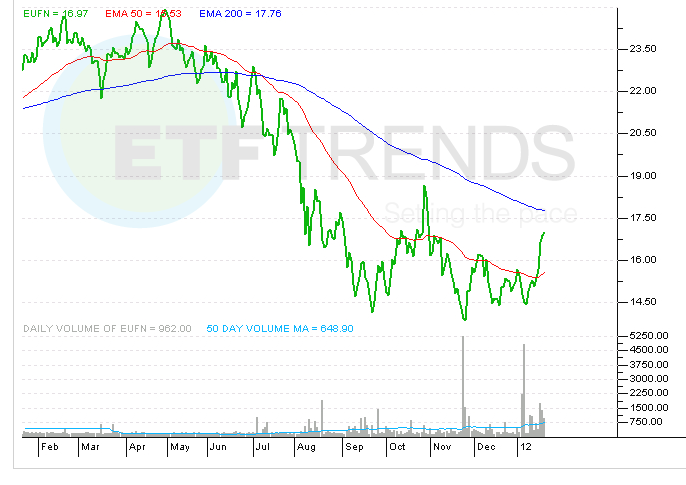
I say this because of the substantial improvement in the price performance of the exchange traded fund indexed to the European financial sector. It has rallied in a way not that dissimilar to U.S. banks following the March 2009 low.
Take a look at the price ratio of the iShares MSCI Europe Financial Sector (EUFN) relative to the Vanguard Europe Pacific ETF (VEA). As a reminder, a rising price ratio means the numerator/EUFN is outperforming (up more/down less) the denominator/VEA.
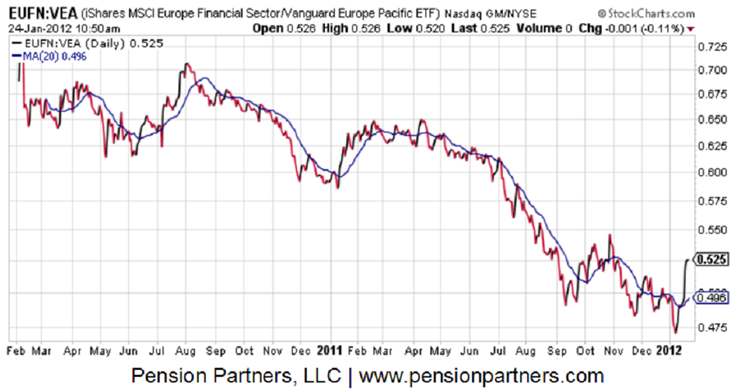
Notice the complete and unrelenting weakness in European financials going back to inception of the ETF, with a substantial amount of underperformance occurring in 2011, even before the summer crash expressed itself in August and September.
What I want to bring your attention to is the sharp spike that’s occurred in the ratio as 2012 started. The spike up suggests that investors in European banks have very suddenly put money back to work into the sector.
They likely would only do this if there was a high degree of confidence that the end of the world would not happen, Europe would continue to exist, and Lehman 2.0 was taken off the table. The strength remains a very bullish sign for the overall global financial system, and may be in its very early stages as market conditions conditions favor the bulls.
iShares MSCI Europe Financial Sector
The author, Pension Partners, LLC, and/or its clients may hold positions in securities mentioned in this article at time of writing. The commentary does not constitute individualized advice. The opinions herein are not personalized recommendations to buy, sell or hold securities.