Temping yields and improved balance sheets at large U.S. companies are among the reasons why some financial advisors are favoring exchange traded funds that invest in investment grade corporate bonds. Paltry yields on offer in Treasury bonds are another factor.
An uncertain global economy has pushed companies to hold onto cash instead of spending it and stiffer government regulation has also forced banks to increase capital and cash reserves, writes Penn Financial Group’s Matthew McCall at Investopedia.
As a result, U.S. companies are sitting on more money, which makes them less at risk to default, he argues. [Emerging Market, High-Yield Bond ETFs Lead October Inflows]
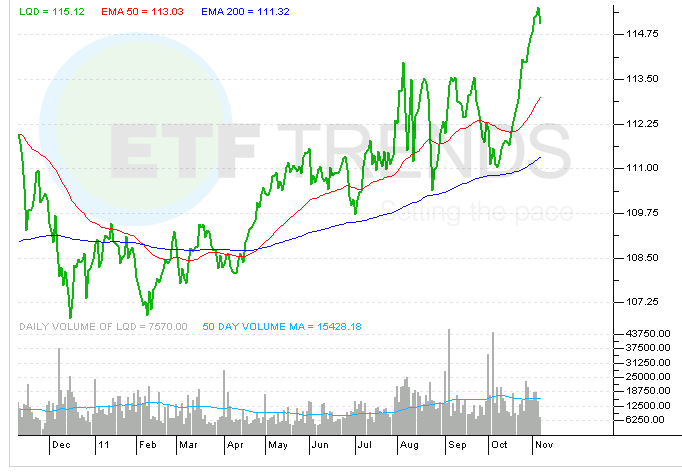
The recent rally brought the iShares iBoxx Investment Grade Corporate Bond ETF (NYSEArca: LQD) to its best levels in eight years, McCall points out.
LQD holds a mix of short-term and long-term investment grade corporate bonds. The fund has an expense ratio of 0.15% and a 12-month yield of 4.49%. The ETF is up 10.35% year-to-date.
Other corporate bond ETFs include iShares 1-3 Year Credit Bond (NYSEArca: CSJ) and Vanguard Short-Term Corporate Bond ETF (NasdaqGM: VCSH).
With Treasury yields at historical lows and no real guarantee that inflation won’t eat away at returns, corporate bonds and related ETFs may be more attractive than U.S. Treasuries. In fact, corporate bond ETFs look cheap compared to Treasuries, some argue. [Corporate Bonds are Attractive: ETF Strategist]
iShares iBoxx Investment Grade Corporate Bond ETF
For more information on corporate bonds, visit our corporate bonds category.
Max Chen contributed to this article.