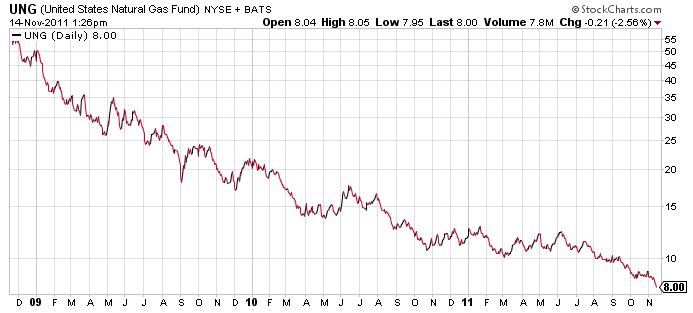
Exchange traded funds tracking natural gas futures fell to new all-time lows on Monday as prices have been hurt by warm weather in the U.S.
The $1.3 billion U.S. Natural Gas Fund (NYSEArca: UNG) was down 2.5% on Monday and traded below $8 a share for the first time.
Other exchange traded products that follow natural gas prices and producers include iPath Dow Jones-UBS Natural Gas ETN (NYSEArca: GAZ), First Trust ISE-Revere Natural Gas Index Fund (NYSEArca: FCG), Teucrium Natural Gas (NYSEArca: NAGS) and U.S. 12 Month Natural Gas Fund (NYSEArca: UNL).
“Temperatures across the eastern half of the U.S. are expected to remain above average over the next week, reducing the need for gas used to heat homes and businesses,” Dow Jones Newswires reported. “Forecaster WSI Energycast said temperatures as much as 15 degrees above normal are expected in some U.S. regions over the next ten days, with the East Coast and South expected to see temperatures ‘much above normal.’ Mild weather in recent months has fueled larger-than-average increases in U.S. gas stockpiles, intensifying the supply glut currently weighing on prices.”
U.S. Natural Gas Fund was down 31.5% year to date as of Nov. 11, according to Morningstar.
The ETF “invests in near-month futures contracts, and as each month draws to a close it has to ‘roll’ its position forward,” Morningstar writes in profile. “Effectively, the fund sells its soon-to-expire position and purchases a contract further from expiry to avoid physical delivery. When the prices of those back-month contracts exceed the price of the front-month contract (known as a state of contango’), the fund loses money each time it rolls its position.”
American households that use natural gas to heat their homes will see lower costs this year. “In a typical November, natural gas prices start rising in anticipation of higher demand, but this year a supply glut is weighing on the market. It has been 10 years since prices were this low heading into the winter,” WSJ.com reports.
U.S. Natural Gas Fund
Full disclosure: Tom Lydon’s clients own UNG.