This time of year, as we approach colder weather in much of the United States, natural gas exchange traded funds and notes often become more active than usual as traders posture themselves for potential moves in the gas futures markets, which are historically highly related to weather patterns.
Volumes have accelerated recently in these exchange traded products with potential hedging or directional trading strategies being enacted, but largely the funds are toiling at multi-year lows.
For instance, the largest fund that tracks natural gas from an assets under management standpoint with $1.3 billion, U.S. Natural Gas Fund (NYSEArca: UNG), which is structured as an ETF, is down a whopping 34.47% just year to date and is down 92.08% since inception in April of 2007. [Natural Gas ETFs Punished by Weather, Supply]
The iPath Dow Jones-UBS Natural Gas ETN (NYSEArca: GAZ) has fallen even further, losing 41.60% year to date.
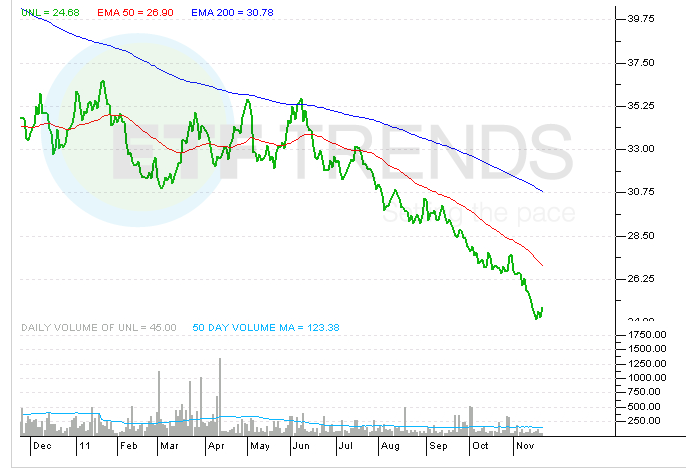
U.S. 12 Month Natural Gas Fund (NYSEArca: UNL) was created in late November of 2009 to mitigate the effects of contango in the natural gas futures market (where distant futures are more expensive than front month futures, causing fund investors to “lose” when the funds methodically “roll” their futures positions each month heading into expiration). [Commodity ETFs: Understanding Contango]
Year to date, UNL has displayed the ability to deliver better fund performance than UNG, but it is still down considerably this year, down 29.42%, and has lost 49.89% since inception. Since contango has negatively impacted those looking for natural gas exposure in their ETF portfolios in recent years, a number of products have been launched in addition to UNL with intentions to limit the effects of this potential “state” in the futures markets.
The iPath Seasonal Natural Gas ETN (NYSEArca: DCNG) is designed to track a rolling position in Henry Hub Natural Gas futures in the Barclays Capital Natural Gas Seasonal Total Return Index.
Likewise, E-TRACS Natural Gas Futures Contango ETN (NYSEArca: GASZ) seeks to capitalize on the effects of contango by providing short exposure to front month natural gas futures and long exposure in mid-term futures. Since inception in June of this year, GASZ is up 6.00% versus UNG down 28.89% during the same time frame.
Teucrium Natural Gas (NYSEArca: NAGS), which is also an ETF, debuted this year as well with the goal of reducing effects of contango and backwardation.
Instead of investing solely in front month gas contracts and then employing a methodical roll such as UNG, NAGS invests in a weighted average of March, April, October, and November Henry Hub Natural Gas futures contracts.
Since inception in February of this year, NAGS is down 36.78% versus UNG losing 33.46% during this time period.
Finally, for those looking to employ leveraged directional trading strategies tied to the Natural Gas futures market, ProShares UltraShort DJ-UBS Natural Gas (NYSEArca: KOLD) delivers 2 times the daily inverse return of the DJ-UBS Natural Gas Subindex, and ProShares Ultra DJ-UBS Natural Gas (NYSEArca: BOIL) tracks 2 times the returns on the long side of the same index.
With a variety of ETF/ETN options now available in the natural gas space and given the disappointing performance of UNG and some others this year, we are expecting tax-loss harvesting and potential ETF/ETN tax swap activity to occur going into the final weeks of this year. [ETFs and Tax-Loss Harvesting]
U.S. 12 Month Natural Gas Fund
For more information on Street One ETF research and ETF trade execution/liquidity services, contact pweisbruch@streetonefinancial.com.