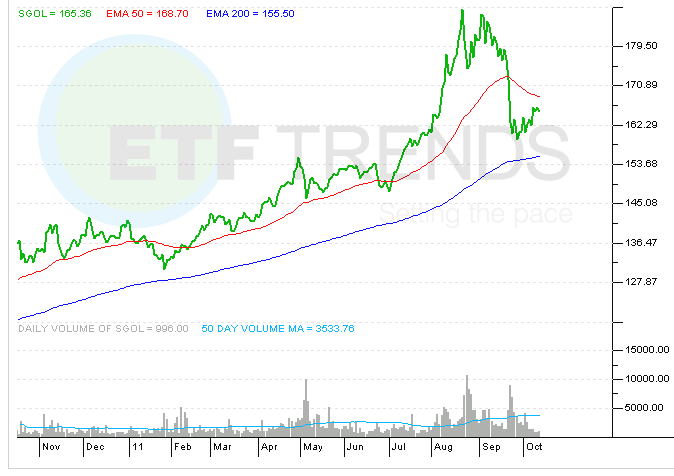
Gold exchange traded funds have pulled back over the past month after setting new highs amid reports investors were selling the precious metal to raise cash to meet margin calls.
“The gold price dropped as much as 16% from its all time high during the risk asset correction of the past month. The sharp drop has caused many investors to question whether the metal has lost its status as a safe haven asset and ‘tail risk’ hedge,” wrote Nicholas Brooks and Daniel Wills at ETF Securities in a research note Thursday.
The firm manages ETFS Physical Swiss Gold Shares (NYSE: SGOL), which is down 9% over the past month but still sports a 17% year-to-date gain.
Gold prices are trying to regain $1,700 an ounce after briefly climbing above $1,900 in August. Gold bulls say the fundamental drivers of the multiyear rally remain intact, including the Eurozone debt crisis, gridlock over the U.S. deficit and currency debasement. [How Do You Value Gold ETFs?]
“The recent gold price drop is consistent with its performance during previous risk asset corrections, with financial deleveraging and a demand for immediate cash liquidity being the likely main causes of the recent price correction,” ETF Securities said.
The sell-off resembles the deleveraging stage of the 2008 financial crisis when gold plunged 38% between July and October.
“However, over the next four months gold demand rebounded strongly, with the price fully recouping its initial losses and then pushing on to nearly double over the next few years,” the analysts wrote.
Despite gold’s resilience, its sharp declines in liquidity-driven sell-offs in recent years have raised questions over its value as disaster insurance.
The precious metal has also taken hits from recent increases in margin requirements to trade gold futures, which have taken away some of the speculative momentum.
Still, the price decline in September hasn’t shaken gold ETF investors, according to the report.
“Gold exchange traded product investors largely held their positions through the price correction, as did physical investors, indicating short-term futures investors were the main driver of the gold price sell-off in September,” ETF Securities noted.
In both the 2011 and 2008 corrections, ETF investors “largely held positions through the volatility, accumulating new positions following the initial sharp price decline.”
ETFS Physical Swiss Gold Shares