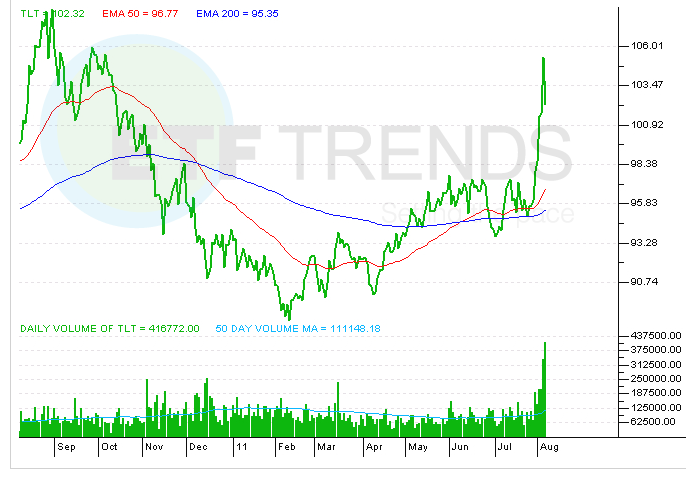
Exchange traded funds that invest in U.S. Treasuries were actually set to rally on Monday after Standard & Poor’s downgraded its rating on government debt as investors sold riskier assets such as stocks and commodities and moved into gold and bonds.
Despite the S&P ratings cut, “we think it is vital to underscore the fact that the U.S. Treasury sector … remains the largest and most liquid fixed income market in the world with the greatest degree of price transparency and few genuine alternatives,” ETF manager BlackRock said in a statement over the weekend.
“While the events that led to the S&P downgrade are certainly of concern, we think the vast majority of investors will continue to utilize the Treasury yield curve as an effective credit risk-free benchmark against which credit spread issues can be judged,” BlackRock said.
“Treasuries will also continue to see a strong bid from institutional investors of all kinds (including banks) and will continue to serve their traditional role as a hedge to risk assets,” the investment manager added. “While a time may come when the credit risk-free status of Treasury bonds is diminished by continued policy missteps, we do not believe that the S&P downgrade signals that this moment has come now.”
ETFs tracking stocks and oil were set for large declines Monday in the wake of the S&P downgrade. Gold and U.S. Treasury ETFs were moving higher. [Stock ETFs Drop]
“Nothing is risk free anymore,” said Nicholas Colas, chief market strategist at ConvergEx Group. “All modern financial theory is built on the bedrock notion that there is a riskless investment alternative available to any investor who wants it. S&P’s decision puts a torch to that construct.”
Potential S&P downgrades to other triple-A-rated countries such as Germany, France, Canada, Singapore, Switzerland and the U.K. are now on the table, he said.
“Other countries may still have a AAA rating by dint of their fiscal governance, but when the biggest house on the block sells for less than expected, every other homeowner in the neighborhood should reset their notions of value,” Colas said in a note Monday. [Treasury ETFs Rally in Risk-Off Trade]
“Media coverage of the downgrade has emphasized its potential to boost not only Treasury yields but also interest rates paid by consumers and businesses across the economy,” said David Kelly, chief market strategist at JP Morgan Funds. “However, in theory, the downgrade effect should show up immediately since all market participants are now fully aware of it and the extremely low levels of interest rates while the market operated under the threat of a downgrade doesn’t suggest a surge in rates in reaction to it. In time, less market volatility and better economic growth should push interest rates much higher. But if this occurs, it won’t be because of the downgrade.”
iShares Barclays 20+ Year Treasury Bond (NYSEArca: TLT)