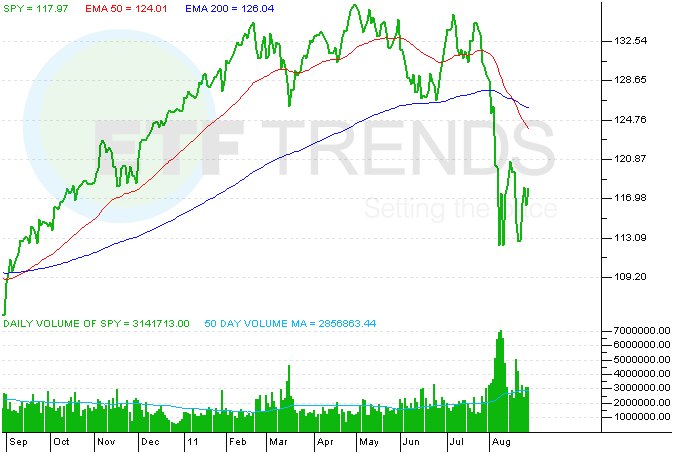
Exchange traded funds and the broader stock markets have been moving as a pack during the volatile “risk-on” and “risk-off” trades and wide swings in market sentiment.
According to Bespoke Investment Group, the S&P 500 is experiencing a high frequency of “all or nothing” days. In other words, stocks have been moving in unison — they tend to moving higher or lower as a group.
Over the last 20 trading days, 12 “all or nothing” days have been recorded, according to Bespoke. Data since 1990 reveals that during one other period, Ffll of 2008, did we see the same levels of extreme advancing or decline days.
Year-to-date, 32 all or nothing days on the S&P 500 have been recorded.
“While the volatility of the credit crisis has certainly contributed to the uptick in ‘all or nothing’ days over the last few years, an even larger contributor has been the ETF industry,” according to Bespoke. “It is not a coincidence that the increase in ‘all or nothing’ days has risen right in tandem with the explosion in volume of ETFs like SPY.” [Are ETFs Responsible for Rising Market Correlations?]
Correlations in equities have risen lately. High correlations are not indicative of a healthy or normal market, analysts say. A higher correlation means prices are moving together, rather than going their separate ways. [Sector ETF Correlations at Two-Year High: Strategist]
SPDR S&P 500 ETF (NYSEArca: SPY)
For more information on the stock market, visit our S&P 500 category.
Max Chen contributed to this article.
Full disclosure: Tom Lydon’s clients own SPY.